RELATIONSHIP ASTROLOGY
What Is Synastry?
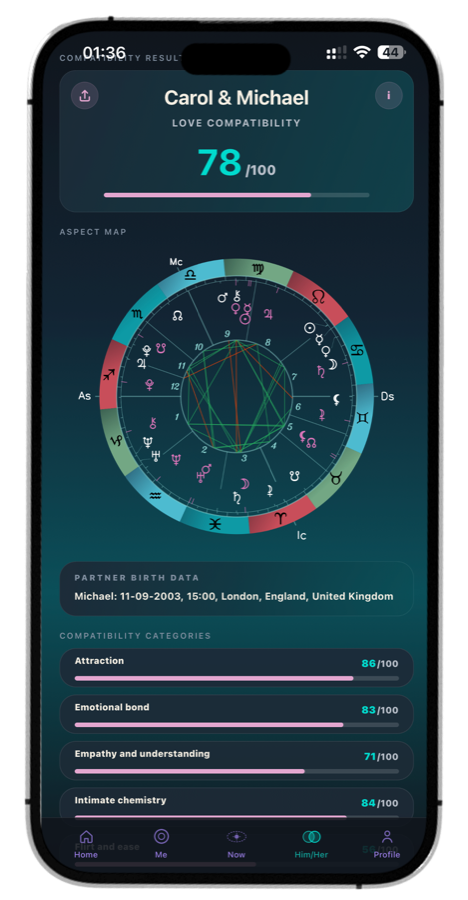
Synastry is the branch of astrology that compares two birth charts to understand how two people interact. Instead of asking whether two zodiac signs are compatible, synastry looks at the exact planetary positions in both charts. It asks how one person’s Sun, Moon, Mercury, Venus, Mars, Saturn and other placements aspect the other person’s planets and where those planets fall in each other’s houses.
SYNASTRY BASICS
Synastry compares two birth charts through cross-chart planetary aspects.



Synastry compares two real charts
A basic sun-sign match can only compare one placement from each person. Synastry compares the whole chart. One person’s Venus may trine the other person’s Mars, creating attraction and ease. One person’s Moon may square the other person’s Mercury, creating emotional misunderstandings. One person’s Saturn may conjunct the other person’s Sun, bringing seriousness, loyalty or pressure.
This is why synastry can describe relationships with more nuance than simple sign compatibility. Two people with “incompatible” Sun signs may have beautiful Moon, Venus or Mercury contacts. Two people with “compatible” Sun signs may still struggle if their emotional needs, communication styles or Saturn patterns clash.
Synastry is about interaction, not verdicts
Synastry does not prove whether two people should be together. It describes how the charts interact. It can show attraction, comfort, tension, timing, loyalty, growth and challenge. A difficult synastry aspect is not a relationship death sentence. A harmonious aspect is not a guarantee of commitment. People still need maturity, communication and choice.
The most useful synastry reading asks what the relationship teaches and how the two people experience each other. Some contacts feel easy and supportive. Others create friction that can become growth or exhaustion depending on awareness. Synastry gives language to the pattern, not a final command.
The most important synastry contacts
Moon contacts are often central because they describe emotional safety, attachment and daily comfort. Venus and Mars contacts describe affection, desire, chemistry and attraction. Mercury contacts describe communication, listening and mental rhythm. Saturn contacts describe responsibility, commitment, pressure and long-term structure. Sun contacts describe recognition, vitality and identity exchange.
House overlays add another layer. If your partner’s planets fall in your seventh house, they may activate partnership themes. In the fourth house, they may feel familiar, private or family-oriented. In the eighth, they may stir intimacy, trust and deep emotional material. The houses show where the other person enters your life.
Synastry can apply to many relationships
Synastry is not only for romance. It can be used for love, family, friendship, work partnerships and creative collaborations. Venus and Mars may matter more in romantic chemistry, while Mercury, Saturn and the sixth or tenth houses may matter more in work compatibility. Moon and fourth-house contacts can be important in family and caregiving relationships.
The relationship type changes the emphasis. A passionate Venus-Mars square may be exciting in romance but irrelevant in a professional partnership. A strong Saturn-Mercury contact may feel serious in friendship but useful in business. Good synastry reading respects context.
Strong synastry needs both attraction and safety
A relationship can have powerful attraction but still feel unstable if emotional safety is missing. It can also feel emotionally safe but lack desire or movement. This is why synastry should look at several categories together. Venus and Mars may explain chemistry, but the Moon explains comfort, Mercury explains communication and Saturn explains whether the connection can handle time and responsibility.
The strongest synastry readings avoid one-symbol conclusions. They show where two people naturally meet, where they miss each other and where conscious effort can help. That kind of reading is much more useful than saying a relationship is simply good or bad.
Synastry becomes clearer with relationship category
The same chart contact can mean different things in love, friendship, family or work. Zodigo keeps that context visible so a compatibility reading does not force romantic meanings onto every bond.
How Zodigo reads synastry
Zodigo compares two charts and organizes compatibility into understandable categories instead of reducing everything to one sign match. You can explore attraction, emotional bond, communication, trust, daily rhythm, tension and long-term potential through real planetary contacts.
General synastry teaches the language. Zodigo helps you apply it to actual birth data, so you can see how one person’s chart interacts with another person’s chart in a personal and practical way.
Synastry depends on two correctly calculated charts. Zodigo uses a licensed, high-precision planetary calculation engine before comparing planets, houses, aspects and compatibility categories between two people.
FAQ
What Is Synastry? questions
What does synastry mean?
Synastry is the comparison of two birth charts to understand relationship dynamics and compatibility.
Is synastry only for romantic relationships?
No. It can be used for love, family, friendship, work and creative partnerships.
Is synastry more accurate than zodiac compatibility?
It is more detailed because it compares full birth charts instead of only Sun signs.
Do you need birth time for synastry?
Birth time helps with houses and angles, but planet-to-planet aspects can still be read without it.
Inside the Zodigo app
An astrology app powered by high-precision NASA/JPL data
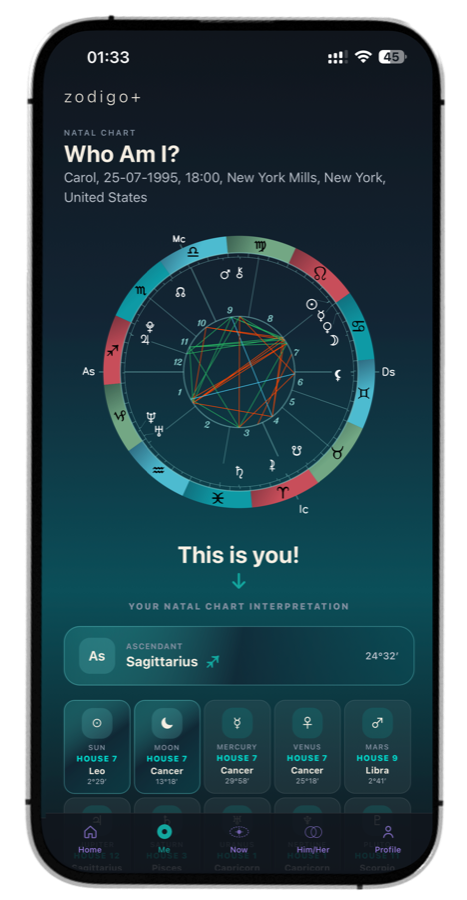
Your personal birth chart
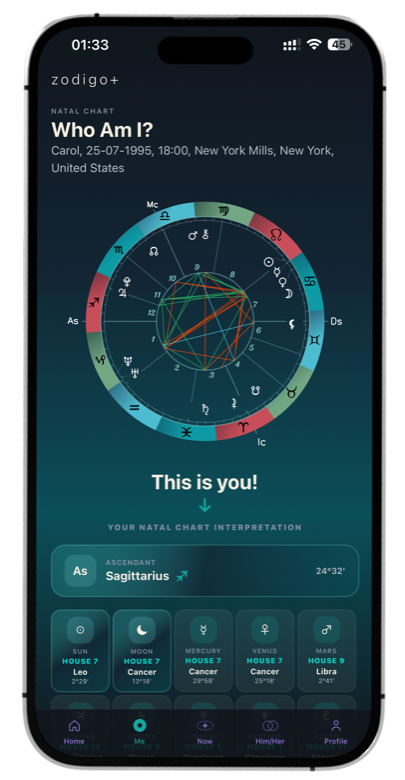
See planets, houses, and aspects calculated from your exact birth details.
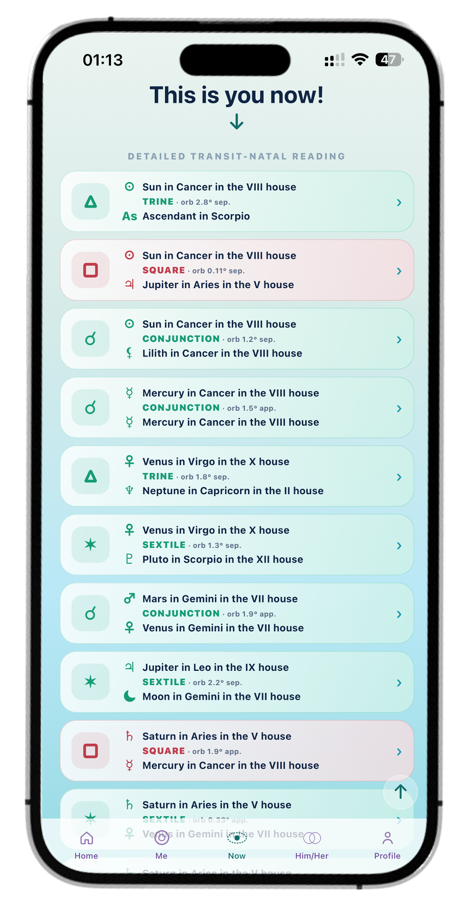
Transits right now
Follow the current sky and see how each transit affects your natal chart and all your personal planets.
Compatibility
Compare two natal charts and get a detailed synastry reading for love, family, friendship, or work. Explore attraction, emotional closeness, communication styles, points of tension, and long-term relationship dynamics through the aspects between two people's planets.