BIRTH CHART BASICS
What Is a Birth Chart?
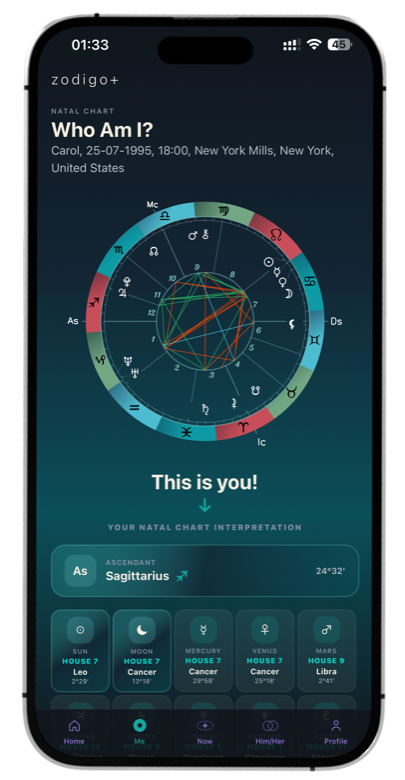
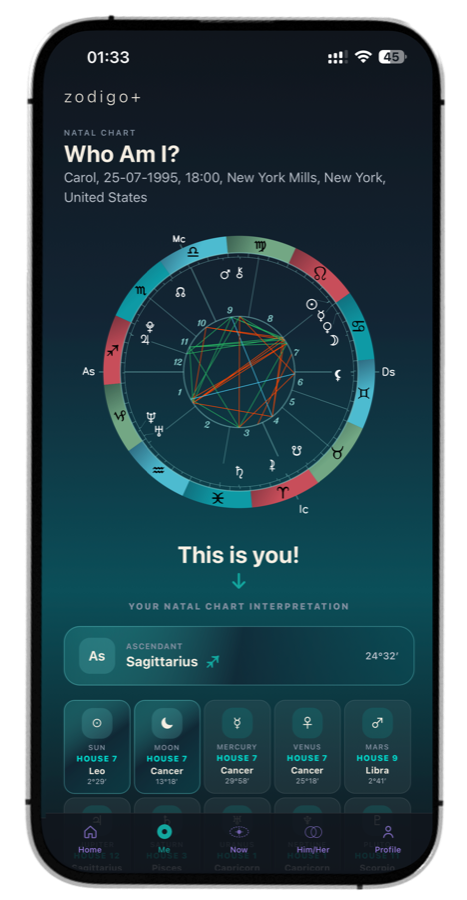
A birth chart, also called a natal chart, is a map of the sky calculated for the exact date, time and place you were born. It shows where the Sun, Moon, planets and important chart points were located in the zodiac and in the twelve houses. In astrology, this chart becomes the starting point for understanding personality patterns, emotional needs, timing, relationships and personal cycles.
PLANETS AND SIGNS
A natal chart becomes personal when planets, zodiac signs, houses and aspects are read together.
A birth chart is more than your zodiac sign
Most people first meet astrology through a zodiac sign: Aries, Taurus, Gemini and so on. That usually means the Sun sign, the sign where the Sun was located at birth. The Sun sign matters, but it is only one part of the full chart. A real natal chart also includes the Moon, Mercury, Venus, Mars, Jupiter, Saturn, Uranus, Neptune, Pluto, the Ascendant, the Midheaven and the twelve houses.
This is why two people with the same Sun sign can feel completely different. One Leo may have a Scorpio Moon, Virgo rising and several planets in the tenth house. Another Leo may have a Pisces Moon, Sagittarius rising and a chart focused on the fourth house. Both share a solar theme, but their emotional style, communication, relationship patterns and life focus can be very different.
How a natal chart is calculated
A birth chart is calculated from three inputs: birth date, birth time and birthplace. The date shows the general positions of the planets. The time and location determine the horizon and meridian at the moment of birth, which create the Ascendant, Midheaven and house structure. This is why exact birth time is important, especially when reading houses, rising sign and time-sensitive chart points.
Astrology uses astronomical positions as calculation inputs, then interprets those positions symbolically. The calculation tells us where the planets were. The interpretation asks what those placements may describe in a person’s temperament, choices, relationships and timing. Those are different layers: calculation is technical; interpretation is symbolic.
The four building blocks: planets, signs, houses and aspects
A useful way to read a chart is to separate four layers. Planets describe what part of life is being expressed. The Moon relates to emotional needs, Mercury to thinking and communication, Venus to affection and values, Mars to drive and conflict style. Signs describe how that planet expresses itself. Houses show where in life the theme tends to appear. Aspects show how planets interact with each other.
For example, Venus in Cancer in the seventh house does not mean the same thing as Venus in Aquarius in the tenth house. The planet is the same, but the sign, house and relationship to other planets change the meaning. This is the main reason a full birth chart gives a more personal picture than a short horoscope based only on a Sun sign.
Why the rising sign and houses matter
The rising sign, or Ascendant, is the zodiac sign rising on the eastern horizon at the birth moment. It shapes the chart layout and begins the first house. Because the Ascendant changes quickly, it depends on accurate birth time. In chart interpretation, it often describes the way a person meets life, reacts to new situations and appears to others before they are known deeply.
The houses divide the chart into life areas: identity, resources, communication, home, creativity, work, relationships, transformation, learning, career, community and inner life. When many planets gather in one house, that area can become especially important. Without reliable birth time, planet-to-sign meanings remain available, but house interpretation becomes less precise.
What a birth chart can and cannot tell you
A natal chart is not a fixed sentence and it should not be treated as a replacement for personal judgment, therapy, medical advice, financial advice or legal advice. The strongest use of a birth chart is pattern recognition. It can give language for repeating emotional themes, communication styles, attraction patterns, ambition, sensitivity, pressure points and timing cycles.
Good astrology does not reduce a person to one label. It compares many placements and asks how they work together. A difficult aspect can describe tension, but it can also show discipline, motivation and growth. A harmonious aspect can describe ease, but it can also be underused if the person does not consciously develop it.
Common mistakes when reading a birth chart
The most common mistake is to treat one placement as the whole person. A sentence like “Venus in Gemini means someone cannot commit” is too flat because Venus also has a house, aspects, dignity, chart context and lived expression. Another common mistake is to read every symbol as equally important. In practice, chart interpretation needs hierarchy. Angular planets, repeated elements, tight aspects and strongly emphasized houses often speak louder than placements that are technically present but less central.
A helpful reading asks how the chart repeats itself. If the Moon, fourth house and Cancer placements all point toward safety and belonging, that theme deserves attention. If Mars, the first house and Aries placements all point toward action, courage and conflict, that pattern matters too. Zodigo is built around this fuller view: not one isolated zodiac label, but a connected personal map that can be read from several angles.
How Zodigo makes the chart personal
General astrology explains the pattern. Zodigo helps you see how it works in your own chart, with personal birth chart interpretations, current transits and compatibility insights available for free. Instead of reading only one zodiac sign, you can create your chart, open your planets, houses and aspects, and see how the same astrological idea becomes specific to your birth data.
You can also compare your chart with another person through synastry, then follow current transits to understand what is active now. That makes astrology less generic: the question becomes not only what a placement means in theory, but how it works in your chart and in your timing.
Zodigo does not guess the chart from a Sun sign. It uses a licensed, high-precision planetary calculation engine so planets, angles, houses and aspects can be read from your exact birth data.
FAQ
What Is a Birth Chart? questions
Is a birth chart the same as a natal chart?
Yes. Birth chart and natal chart usually mean the same thing: an astrology chart calculated for the date, time and place of birth.
Can I read a birth chart without birth time?
You can still read planetary signs and many aspects, but the rising sign, Midheaven and houses may not be accurate without birth time.
Is a birth chart more accurate than a horoscope?
It is more personal because it uses the full chart instead of only one zodiac sign. It still remains a symbolic astrology reading, not a scientific prediction.
What should I look at first in my chart?
Start with the Sun, Moon and rising sign, then look at Mercury, Venus, Mars, house emphasis and the strongest aspects.
Inside the Zodigo app
An astrology app powered by high-precision NASA/JPL data
Your personal birth chart
See planets, houses, and aspects calculated from your exact birth details.
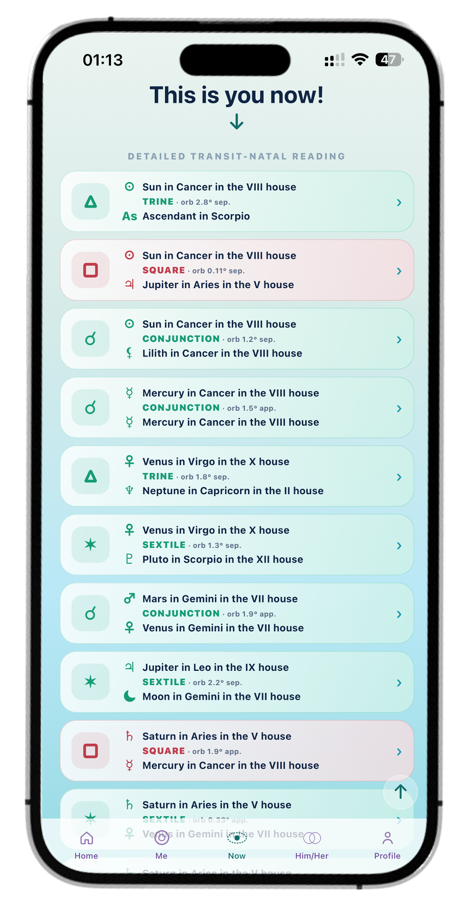
Transits right now
Follow the current sky and see how each transit affects your natal chart and all your personal planets.
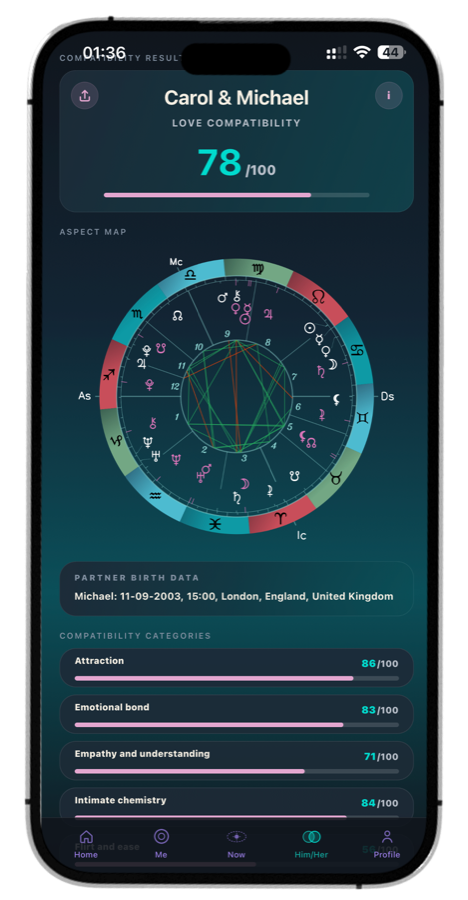
Compatibility
Compare two natal charts and get a detailed synastry reading for love, family, friendship, or work. Explore attraction, emotional closeness, communication styles, points of tension, and long-term relationship dynamics through the aspects between two people's planets.