DAILY PLANNING
How to Use a Personal Transit Timeline
A personal transit timeline shows how the planets moving now interact with your birth chart over time. Instead of reading today’s sky as a general forecast, you can see which transits are active for you, when they peak and what part of life they may describe. This makes daily and weekly astrology easier to use because the information is organized around your chart.
PERSONAL TIMELINE FACTORS
A useful timeline combines current planets, natal placements, aspects, orbs and active houses.

A timeline is different from a transit list
A transit list can show where planets are today. A personal transit timeline shows what those planets are doing to your chart. The difference is important. A list may say Mars is in Gemini. A timeline can show that Mars is squaring your natal Moon, moving through your third house or activating a relationship pattern.
This turns astrology from information into context. You can see what matters to you instead of scanning every possible transit in the sky.
Read the planet first
Start with the transiting planet. The Moon usually describes short emotional rhythm. Mercury describes messages and decisions. Venus describes relationships, values and pleasure. Mars describes action and conflict. Jupiter describes growth. Saturn describes responsibility. Uranus, Neptune and Pluto describe longer changes.
Knowing the planet gives the basic tone before you read the aspect or house.
Then read the natal planet or point
The natal planet being touched shows which part of you is activated. A transit to your Moon may affect feelings and needs. A transit to Mercury may affect thinking and communication. A transit to Venus may affect love, money or attraction. A transit to Saturn may affect duty and boundaries.
Angles can be especially strong because they shape identity, relationships, career direction and home life. This is why exact birth time matters for a personal timeline.
Check the aspect and orb
The aspect shows how the transit interacts with the natal placement. Conjunctions intensify, squares create friction, trines support flow, oppositions create awareness through contrast and sextiles offer opportunity. The orb shows how close the transit is to exact.
A close orb usually feels stronger. A wider orb may still matter, especially with slow planets, but it should not be read with the same intensity as an exact aspect.
Notice what repeats
One transit can be interesting. Repetition is more important. If several transits point to work, responsibility and boundaries, that theme deserves attention. If the Moon activates the same issue that Saturn is already emphasizing, the day may make a larger theme emotionally visible.
A timeline helps you see these patterns instead of treating every transit as isolated.
Use the timeline for reflection and planning
A personal transit timeline can help you plan conversations, work sessions, rest, review periods and emotional check-ins. It can also help you understand why certain days feel more intense. The goal is not control. The goal is awareness.
When you understand the timing, you can respond with more care and less confusion.
Separate short transits from long chapters
A personal timeline usually includes both fast and slow transits. Moon transits may last hours or a couple of days. Mercury and Venus contacts may describe shorter periods. Saturn, Uranus, Neptune and Pluto can describe longer chapters that unfold slowly. Reading them together requires scale.
A brief Moon transit should not be treated like a Saturn return. A long Pluto transit should not be reduced to one emotional day. The timeline helps by showing which influences are temporary and which are part of a larger process.
Use peaks without ignoring buildup
Many transit tools show exact dates, but the buildup matters too. You may feel a transit before it becomes exact, especially if it involves a slow planet or a sensitive natal placement. After the exact date, the theme may continue while you integrate what happened.
This is why a timeline is more helpful than a single alert. It lets you see the surrounding period, not only the peak.
A timeline should help you prioritize
If every transit is treated as equally important, the timeline becomes noise. Prioritize close aspects, personal planets, angles, chart rulers and repeating themes. A good timeline should help you see what matters most now.
This makes daily astrology calmer. You do not need to read every possible sky movement. You need to understand the active patterns that are actually connected to your chart.
How Zodigo builds the timeline
Zodigo builds a personal transit timeline by comparing current planetary positions with your birth chart. That means the timeline is specific to your planets, houses, aspects and timing.
Zodigo uses a licensed, high-precision planetary calculation engine so current planetary positions can be compared with your birth chart instead of turned into generic sign-based advice.
A clear timeline also helps you compare experience with symbolism. When you return to the same transit later, you can see whether the theme repeated, changed or became easier to understand.
FAQ
How to Use a Personal Transit Timeline questions
What is a personal transit timeline?
It is a timeline of current planetary transits compared with your natal chart, showing which personal themes are active over time.
Is a transit timeline better than a daily horoscope?
It is more personal because it uses your birth chart rather than only your Sun sign.
Which transits should I pay attention to first?
Start with close aspects to personal planets, angles and chart rulers, then look at repeating themes.
Can a timeline predict exact events?
It can show timing themes and pressure points, but it should not be treated as a guaranteed event predictor.
Inside the Zodigo app
An astrology app powered by high-precision NASA/JPL data
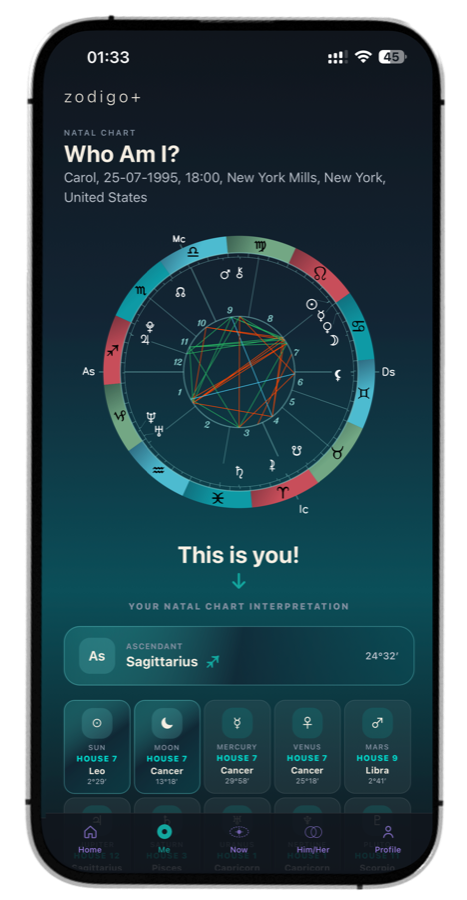
Your personal birth chart
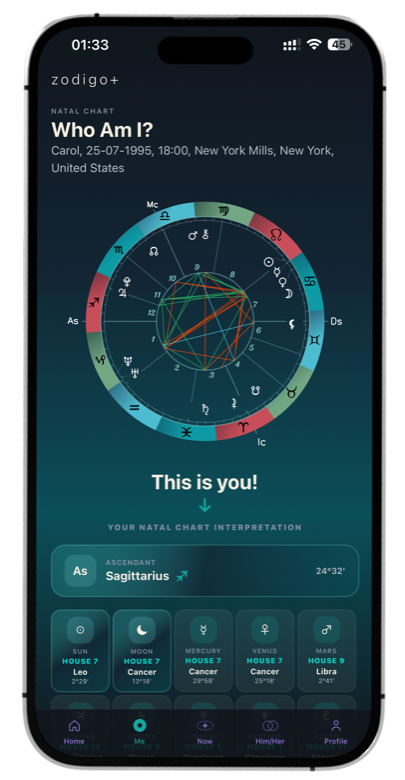
See planets, houses, and aspects calculated from your exact birth details.
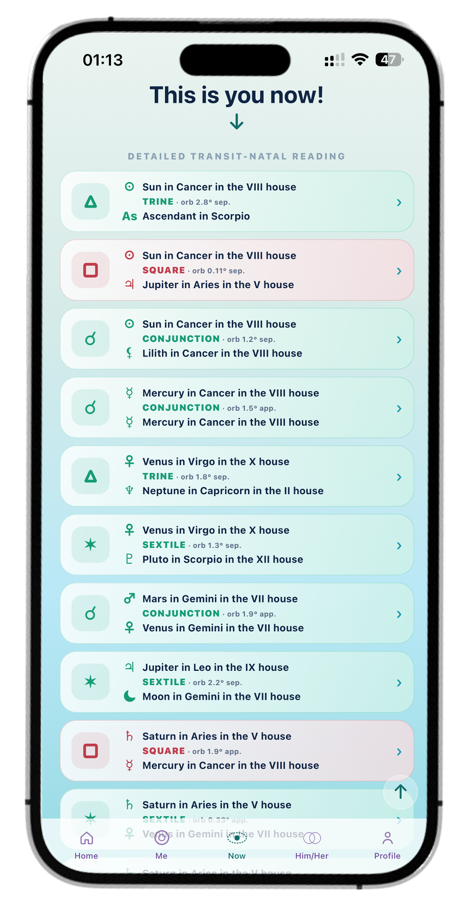
Transits right now
Follow the current sky and see how each transit affects your natal chart and all your personal planets.
Compatibility
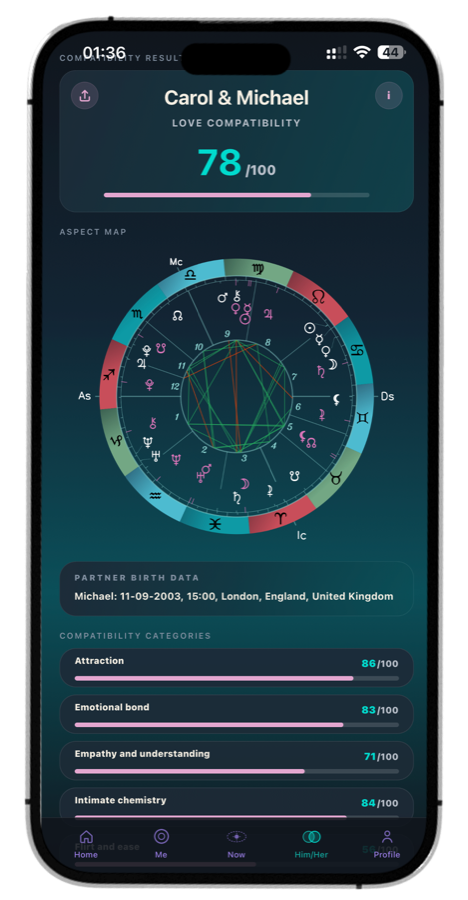
Compare two natal charts and get a detailed synastry reading for love, family, friendship, or work. Explore attraction, emotional closeness, communication styles, points of tension, and long-term relationship dynamics through the aspects between two people's planets.