PLANETARY ASPECTS
What Is an Orb in Astrology?
An orb in astrology is the distance between an exact aspect and the real position of two planets. If a square is exact at 90 degrees and two planets are 92 degrees apart, the orb is 2 degrees. Orbs help astrologers decide how strong an aspect is. A tight orb usually feels more direct and powerful. A wide orb may still matter, but it often works more subtly or depends on the planets involved.
ORB AND ASPECT DEGREES
The orb shows how close an aspect is to exact and helps rank its strength.


Why exact degrees matter
Aspects are based on geometry. A conjunction is exact at 0 degrees, a sextile at 60, a square at 90, a trine at 120 and an opposition at 180. Real charts are rarely perfectly exact. The orb tells us how close the planets are to that ideal angle. The closer the aspect, the more concentrated the connection usually feels.
This is one reason two people can both have Venus square Saturn but experience it differently. One person may have the square within half a degree. Another may have it at seven degrees. The first person may feel the pattern as a central life theme, while the second may experience it more lightly or only when transits activate it.
Not every planet uses the same orb
Many astrologers allow wider orbs for the Sun and Moon because they are luminaries and tend to be very important in chart interpretation. Personal planets often use moderate orbs. Outer planets may use tighter orbs unless they contact personal planets or angles. There is no single rule used by every astrologer, but the principle is the same: closer aspects are stronger.
Context matters more than a mechanical number. A wide aspect to the chart ruler may still be meaningful. A tight aspect between two slow planets may describe a generational theme unless it connects to a personal point. Good interpretation asks how the aspect fits the whole chart.
Applying and separating aspects
Some astrologers also look at whether an aspect is applying or separating. An applying aspect is moving toward exactness. A separating aspect has already passed exactness. In natal interpretation, this can add nuance. In transit work, it is especially important because it shows whether a transit is building, exact or fading.
For example, a Saturn square to the natal Moon may feel heavier as it approaches exactness. After it separates, the lesson may still be present, but the pressure often begins to change. Orbs help track the timing of that process and prevent every possible aspect from being treated as equally active.
Orbs keep astrology precise
Without orbs, astrology becomes too vague. If every planet near any aspect is treated the same, the chart loses priority. Orbs help identify which contacts are loudest. They also help avoid overinterpreting weak or accidental connections. This is especially important in compatibility readings, where two charts can create many possible contacts.
In synastry, a tight Moon-Venus aspect may feel much more personal than a very wide one. A tight Saturn contact may describe a serious bond or pressure. A wide Mars contact may be present but less defining. Orbs help separate major themes from background noise.
Orb is one reason astrology needs calculation
People often read a placement online and assume the meaning is fixed, but aspect interpretation depends on exact degrees. A planet at 2 degrees of Leo is not making the same contacts as a planet at 27 degrees of Leo. The sign is the same, but the geometry is different. Orbs make astrology mathematical before it becomes interpretive.
This is especially important when comparing charts or reading transits. A person may think a transit is active for months, but the strongest window may be much shorter around exact contact. Another aspect may be present in the background but not strong enough to dominate the reading. Good orb handling keeps the interpretation focused and honest.
How Zodigo uses orb context
Zodigo does not treat all aspects as equal. It looks at the planets involved and the closeness of the aspect so the reading can focus on what matters most. This makes the interpretation more useful than a simple list of every possible contact.
When you read your chart in Zodigo, you can see aspect patterns with more personal relevance. The goal is not to overwhelm you with symbols, but to show which connections are strong enough to shape personality, timing and relationships.
Zodigo uses a licensed, high-precision planetary calculation engine to calculate aspect geometry and orbs before turning those patterns into readable interpretations.
FAQ
What Is an Orb in Astrology? questions
What does orb mean in astrology?
Orb is the distance between an exact aspect angle and the real planetary positions.
Is a smaller orb stronger?
Usually yes. Tight aspects tend to be more noticeable and important.
What orb should I use?
It depends on the planets, aspect type and method, but context matters more than one universal number.
Do orbs matter in synastry?
Yes. Tight synastry aspects usually feel more direct than wide ones.
Inside the Zodigo app
An astrology app powered by high-precision NASA/JPL data
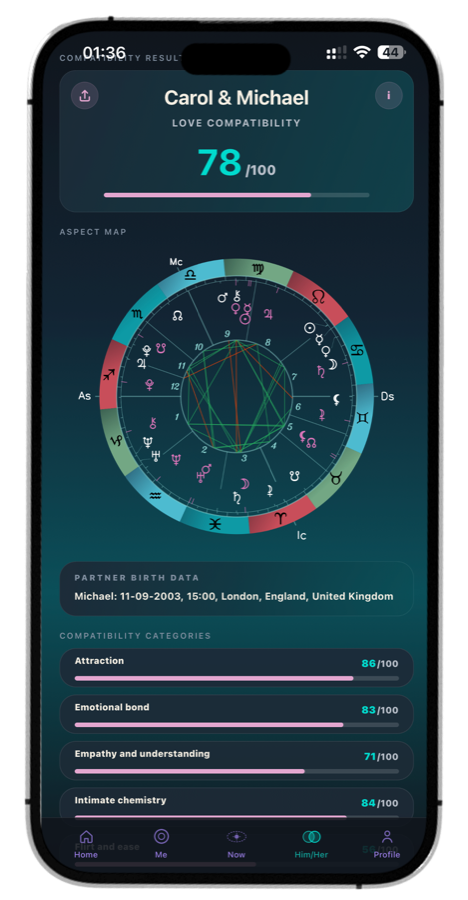
Your personal birth chart
See planets, houses, and aspects calculated from your exact birth details.
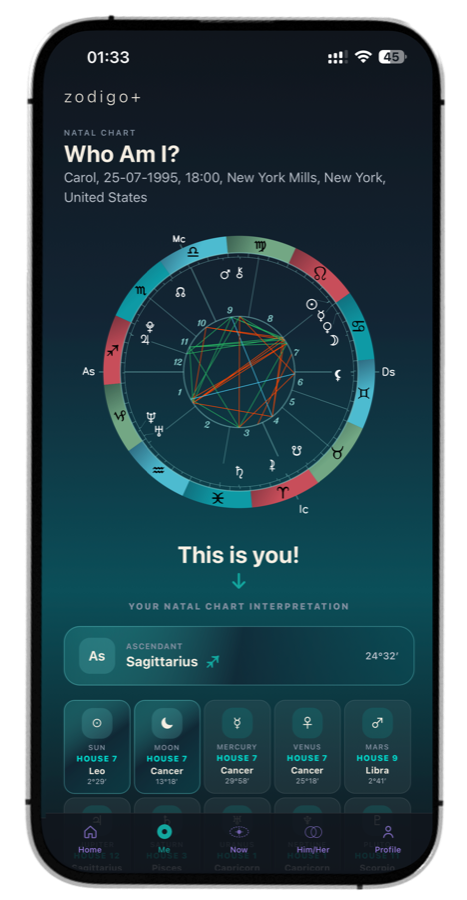
Transits right now
Follow the current sky and see how each transit affects your natal chart and all your personal planets.
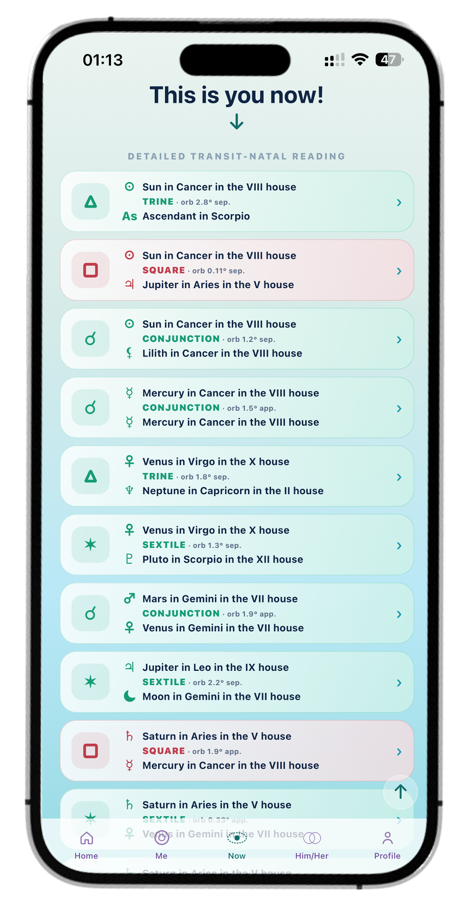
Compatibility
Compare two natal charts and get a detailed synastry reading for love, family, friendship, or work. Explore attraction, emotional closeness, communication styles, points of tension, and long-term relationship dynamics through the aspects between two people's planets.