BIRTH CHART BASICS
How to Read Your Birth Chart
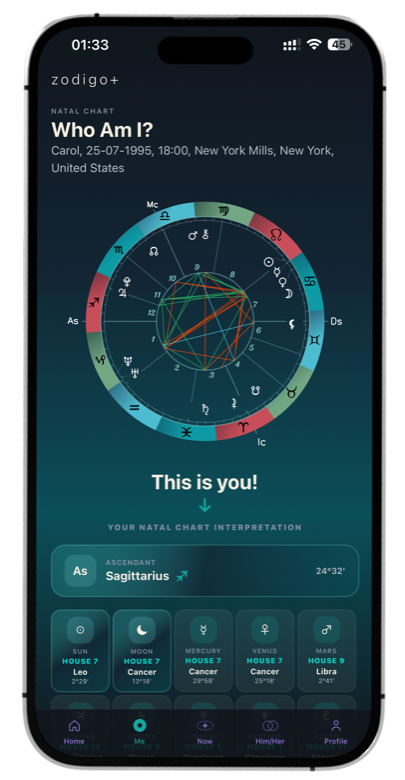
To read your birth chart, start with the main structure: planets, zodiac signs, houses and aspects. The planet shows what part of life is active, the sign shows how it expresses itself, the house shows where it tends to appear, and aspects show how different parts of the chart interact. A good reading does not isolate one placement. It builds meaning from the whole pattern.
FIRST PLACEMENTS TO READ
Start with the personal planets, then connect each one to its sign, house and aspects.
Start with the big three
The easiest doorway into a birth chart is the Sun, Moon and rising sign. The Sun describes core identity, will and the way a person tries to become more fully themselves. The Moon describes emotional needs, instinctive reactions and the private inner world. The rising sign, also called the Ascendant, describes how the chart meets life and how the houses are arranged.
These three points give a quick orientation, but they are not the whole chart. A person with a Leo Sun, Cancer Moon and Virgo rising will read very differently from someone with a Leo Sun, Aquarius Moon and Scorpio rising. Start with the big three because they organize the chart, then keep going.
Read planets as functions
Each planet represents a function of experience. Mercury shows thinking, language and decision-making. Venus shows attraction, values, taste and relationship style. Mars shows desire, effort, anger and direct action. Jupiter expands, Saturn structures, Uranus disrupts, Neptune dissolves and Pluto intensifies. The Moon and Sun are technically luminaries, but in astrology they work like central chart factors.
When you read a planet, ask a simple question: what is this planet trying to do? Mercury wants to connect information. Venus wants to relate and evaluate. Mars wants to act. This keeps the reading clear before you add signs, houses and aspects.
Add signs and houses
The sign describes the style of the planet. Mercury in Gemini may process quickly, compare information and ask many questions. Mercury in Capricorn may prefer structure, proof and practical usefulness. Neither placement is better. They simply describe different ways the same planetary function may operate.
The house describes the life area. Venus in the second house may focus on values, money, body comfort and self-worth. Venus in the seventh house may become more visible through partnership, attraction and negotiation. The sign tells you how; the house tells you where.
Use aspects to connect the story
Aspects are the geometric relationships between planets. They show where chart factors support, challenge, intensify or activate each other. A Moon-Saturn aspect can make emotional life more serious or guarded. A Mercury-Jupiter aspect can broaden thinking and storytelling. A Venus-Mars aspect can make attraction and desire more visible.
Do not read an aspect as automatically good or bad. A trine may show ease, but ease can become passive. A square may show tension, but tension can build skill and strength. The best chart reading asks how the person may experience, develop and consciously work with the pattern.
Look for repetition and emphasis
A chart becomes clearer when you notice repeated themes. Many planets in water signs may emphasize feeling, memory and sensitivity. Many planets in the tenth house may pull attention toward career, visibility and responsibility. Several hard aspects to Mercury may make communication a central growth area.
Repetition matters more than one dramatic placement. If the same theme appears through a sign, a house and multiple aspects, it is probably important. This is how a reading becomes coherent instead of a long list of disconnected interpretations.
Read the chart as a conversation, not a checklist
A birth chart becomes clearer when you stop reading it as a list of separate definitions and start reading it as a conversation. The Moon may want comfort, while Saturn asks for control. Venus may seek closeness, while Uranus needs freedom. Mars may push forward, while Neptune softens direction. These inner dialogues are often what people recognize most in a good natal chart reading because they describe real complexity instead of a single personality label.
After the big three, look for repetition. Are many planets in water signs, suggesting emotional sensitivity and intuition? Are several placements in earth houses, pointing to practical concerns, security and tangible results? Are the strongest aspects supportive, tense or mixed? This step is where astrology becomes personal. Zodigo helps by showing the placements and interpretations together, so you can move from “what does this symbol mean?” to “how does this pattern work in my own chart?”
A practical example of chart reading
Imagine a chart with Virgo rising, a Cancer Moon and Venus in the tenth house. A surface reading might say “sensitive, careful and ambitious,” but the chart becomes richer when those pieces are connected. Virgo rising may observe details before acting. Cancer Moon may need emotional safety and familiar rhythms. Venus in the tenth house may care deeply about reputation, creative work or being valued publicly. Together, the person may be practical on the outside, emotionally protective inside and motivated by work that feels both beautiful and meaningful.
This is the kind of synthesis to practice. Do not rush to memorize every possible placement. Read one layer, then ask how it changes the next layer. Zodigo supports that process by placing interpretations inside the chart structure, so you can keep returning to the same map while the meaning becomes clearer.
Use Zodigo for a personal reading
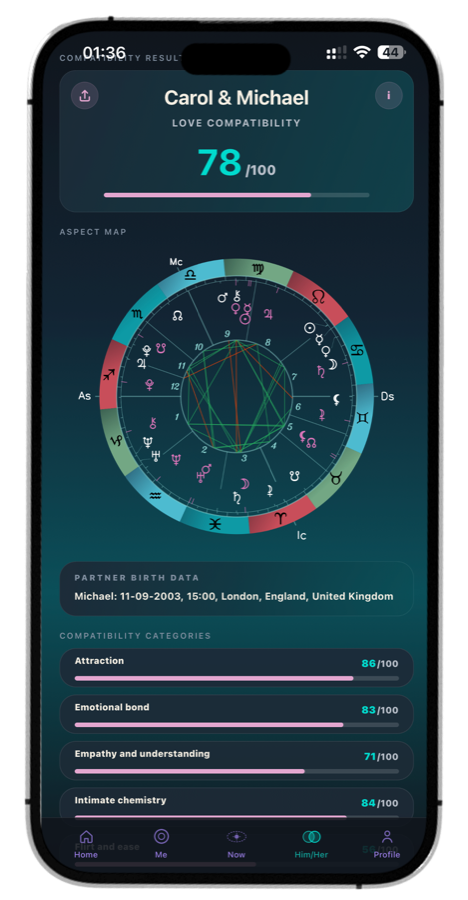
General astrology can teach the method, but your own chart needs your exact birth data. Zodigo helps you create a personal chart and open interpretations for your planets, houses and aspects. You can see how the same placement changes depending on the rest of the chart.
You can also compare your chart with another person and follow current transits. That turns astrology from a generic explanation into a personal map: your birth chart, your timing and your relationship patterns.
Zodigo does not guess the chart from a Sun sign. It uses a licensed, high-precision planetary calculation engine so planets, angles, houses and aspects can be read from your exact birth data.
FAQ
How to Read Your Birth Chart questions
What should I read first in my birth chart?
Start with the Sun, Moon and rising sign, then move to Mercury, Venus, Mars, house emphasis and major aspects.
Can beginners read a birth chart?
Yes. Begin with one layer at a time instead of trying to interpret every placement at once.
Are aspects important in chart reading?
Yes. Aspects show how planets interact, which often explains why a chart feels complex or contradictory.
Do I need exact birth time?
Exact birth time is important for the rising sign, Midheaven and houses. Planet signs can still be read without it.
Inside the Zodigo app
An astrology app powered by high-precision NASA/JPL data
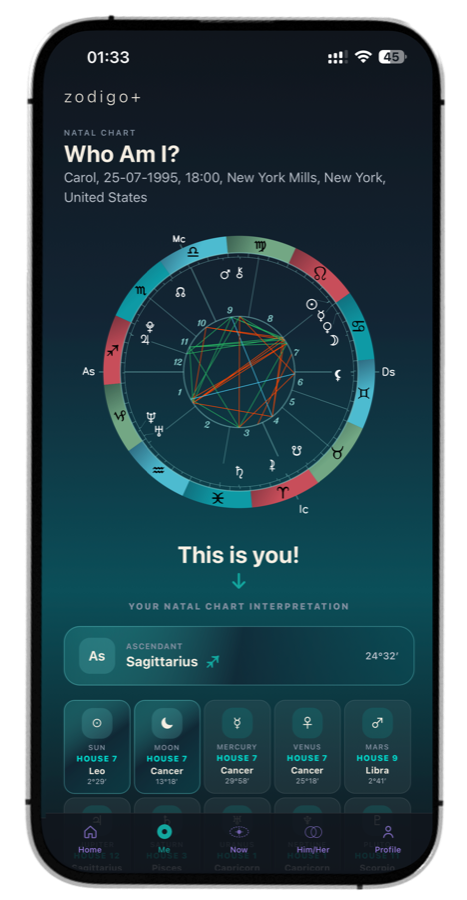
Your personal birth chart
See planets, houses, and aspects calculated from your exact birth details.
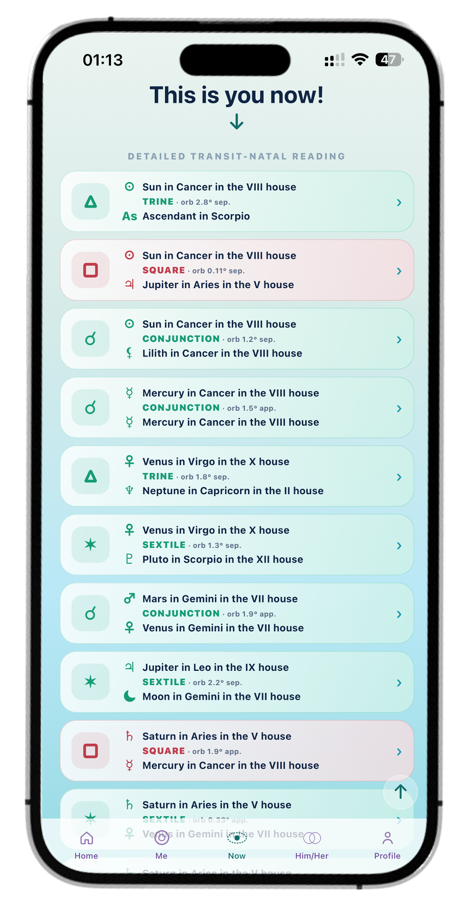
Transits right now
Follow the current sky and see how each transit affects your natal chart and all your personal planets.
Compatibility
Compare two natal charts and get a detailed synastry reading for love, family, friendship, or work. Explore attraction, emotional closeness, communication styles, points of tension, and long-term relationship dynamics through the aspects between two people's planets.