RELATIONSHIP ASTROLOGY
How to Read a Synastry Chart
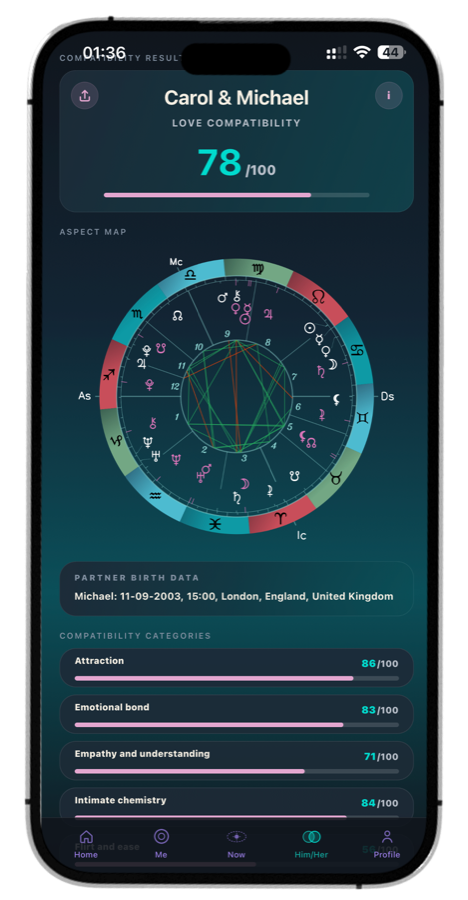
To read a synastry chart, you compare two natal charts and look for the connections between them. The goal is not to memorize every possible aspect. The goal is to identify the strongest relationship themes: emotional safety, attraction, communication, trust, pressure, growth and long-term potential. A good synastry reading starts with the most personal contacts and then builds context.
READING ORDER
Strong synastry readings move from natal patterns to Moon, Venus, Mars, Mercury, Saturn and houses.
Start with both natal charts
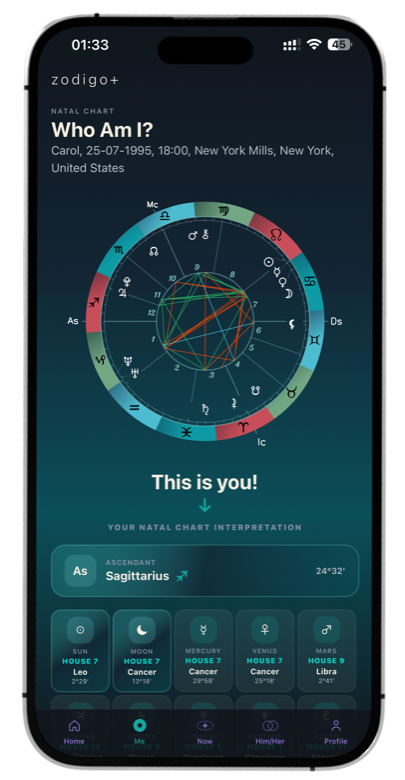
Before comparing two charts, each person’s birth chart should be understood on its own. A person with a cautious Venus will love differently from someone with a bold Venus. A person with a sensitive Moon will need different emotional care than someone with a detached Moon. Synastry shows interaction, but each person brings their own natal pattern into the relationship.
This step prevents shallow interpretation. If one person has natal Moon square Saturn, they may already struggle with emotional safety. When another person’s planets touch that Moon, the relationship can activate an existing pattern. Synastry becomes clearer when the natal chart is not ignored.
Synastry depends on two correctly calculated charts. Zodigo uses a licensed, high-precision planetary calculation engine before comparing planets, houses, aspects and compatibility categories between two people.
Read Sun, Moon and rising connections
Sun contacts can show recognition, admiration and identity exchange. Moon contacts show emotional comfort or emotional friction. Rising sign and angle contacts can create immediate familiarity, attraction or strong first impressions. Sun-Moon aspects between charts are often important because they connect conscious identity with emotional needs.
These contacts are not the whole relationship, but they are a strong beginning. A couple may have little Sun sign compatibility but powerful Moon and angle contacts. Another couple may share Sun sign harmony but struggle emotionally because their Moons are under pressure.
Look at Venus, Mars and Mercury
Venus describes affection, love language, pleasure and values. Mars describes desire, action, conflict and sexual energy. Venus-Mars contacts are often important for romantic attraction. Venus-Venus contacts show whether two people enjoy and value similar things. Mars-Mars contacts show rhythm around action and conflict.
Mercury contacts are essential because relationships live inside communication. Mercury-Moon contacts show whether feelings are understood. Mercury-Mars contacts can create lively conversation or arguments. Mercury-Saturn contacts can create serious discussion, teaching or criticism. Without communication compatibility, even strong attraction can become tiring.
Do not skip Saturn
Saturn is one of the most important planets in long-term synastry. It can show commitment, responsibility, loyalty and durability. It can also show fear, restriction, judgment or heaviness. A relationship with no Saturn contacts may feel free but lack structure. A relationship with too many hard Saturn contacts may feel bonded but burdened.
The quality of Saturn depends on the aspect, the people’s maturity and the rest of the chart. Saturn is not automatically bad. It often appears in serious relationships because it asks whether the connection can survive real life.
Rank the strongest contacts first
A synastry chart can contain many aspects, and not all of them matter equally. Tight aspects between personal planets are usually more noticeable than wide background contacts. Contacts to the Moon, Venus, Mars, Mercury, Saturn and the angles often deserve special attention. Repeated themes also matter: if many contacts point to emotional pressure, that theme should be named.
Reading synastry well means organizing the chart. Start with the strongest contacts, then check whether the same story repeats through houses and aspects. This prevents the reading from becoming a random list and makes it easier to understand what the relationship actually feels like.
Do not ignore repeated patterns
If several aspects repeat the same message, that theme becomes important. One tense Mercury contact may be manageable; many Mercury tensions may show a real communication pattern that deserves attention.
Add house overlays and overall pattern
House overlays show where one person’s planets land in the other person’s chart. A partner’s planets in your fifth house may activate romance and creativity. In your seventh house, partnership. In your eighth, intimacy and vulnerability. In your tenth, public life and ambition. The houses tell the story of where the person enters your world.
Finally, step back and look at the whole pattern. Is there emotional safety? Is there attraction? Is there communication? Is there too much pressure? Is there enough Saturn for durability? Zodigo organizes these layers into readable compatibility categories so the chart comparison becomes useful rather than overwhelming.
FAQ
How to Read a Synastry Chart questions
What should I look at first in synastry?
Start with each natal chart, then Moon contacts, Venus-Mars chemistry, Mercury communication, Saturn and house overlays.
Are Sun signs enough for synastry?
No. Sun signs are only one part of compatibility.
What are house overlays?
They show where one person’s planets fall inside the other person’s houses.
Can synastry show long-term potential?
It can show patterns related to durability, especially through Saturn, Moon and overall chart balance.
Inside the Zodigo app
An astrology app powered by high-precision NASA/JPL data
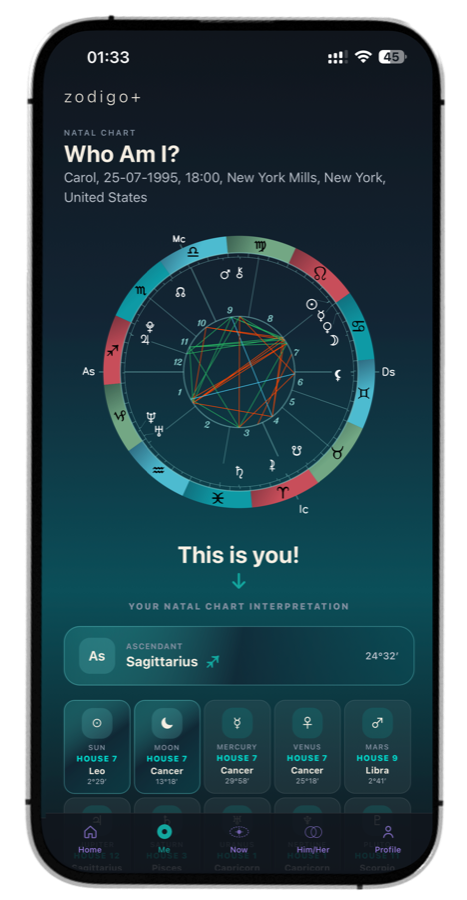
Your personal birth chart
See planets, houses, and aspects calculated from your exact birth details.
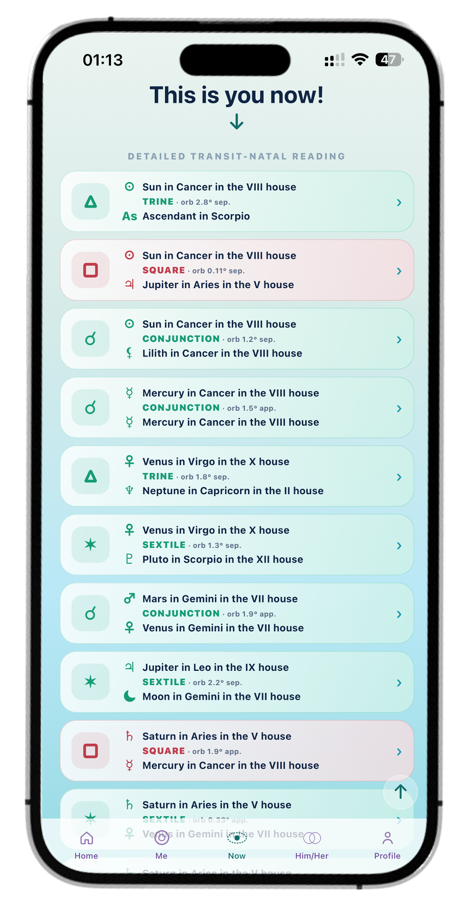
Transits right now
Follow the current sky and see how each transit affects your natal chart and all your personal planets.
Compatibility
Compare two natal charts and get a detailed synastry reading for love, family, friendship, or work. Explore attraction, emotional closeness, communication styles, points of tension, and long-term relationship dynamics through the aspects between two people's planets.