PLANETARY ASPECTS
How Planetary Aspects Shape a Birth Chart
Planetary aspects are the relationships between planets in a birth chart. They show how different parts of the personality interact. The Sun may describe identity, the Moon emotional needs, Mercury thinking, Venus affection, Mars desire, Saturn responsibility and the outer planets deeper collective forces. Aspects connect these functions. Without aspects, a chart is a list of placements. With aspects, it becomes a living system.
ASPECT PATTERNS
A birth chart becomes personal when planet meanings are connected through aspects.


Aspects create inner dialogue
Every planet has a job. Aspects show whether those jobs cooperate, compete, intensify or challenge one another. Moon trine Venus can make emotional comfort and affection flow together. Mercury square Neptune can create a dialogue between logic and imagination. Mars opposite Saturn can describe the push between action and restraint. These contacts explain why a person can feel simple in one area and conflicted in another.
This inner dialogue is often more important than a single zodiac sign. A person may be a Leo Sun, but if that Sun is square Saturn, the Leo expression may be more cautious, serious or self-critical. Another Leo Sun with Sun trine Jupiter may express confidence more easily. The aspect changes how the placement behaves.
Aspect patterns show major themes
Individual aspects matter, but patterns matter even more. A T-square, grand trine, stellium or cluster of repeated contacts can dominate the chart. These patterns show where energy gathers. A chart with many Saturn aspects may emphasize discipline, fear, mastery and time. A chart with strong Neptune contacts may emphasize sensitivity, imagination, spirituality or confusion.
Patterns also show how different life areas connect. If several aspects link the second, sixth and tenth houses, work, money, skill and vocation may be deeply connected. If the fourth, seventh and tenth houses are strongly tied, family, partnership and public identity may shape one another. Aspects are the threads between the rooms of the chart.
Strong aspects deserve priority
A useful chart reading cannot treat every aspect equally. Tight aspects, aspects involving the Sun or Moon, aspects to the Ascendant or Midheaven and aspects involving the chart ruler often deserve special attention. These contacts tend to be more personal and visible. Wide or background aspects may still matter, but they should not drown out the main pattern.
This is why automated lists can feel confusing when they show too many details at once. The real question is priority. Which aspects are strongest? Which repeat the same theme? Which houses do they involve? Which current transits are activating them? A good reading organizes the chart rather than simply naming every symbol.
Aspects evolve through time
Natal aspects describe a lifelong pattern, but the way a person lives them can change. A difficult Mercury-Saturn aspect may feel like shyness in childhood, serious study in young adulthood and professional expertise later in life. A Venus-Uranus aspect may feel unstable at first and later become a mature need for love with freedom and honesty.
Transits also activate natal aspects. When Saturn, Jupiter, Uranus, Neptune or Pluto touches a natal aspect, the theme can become more visible. A person may meet the pattern through events, choices, relationships or internal realizations. The birth chart is stable, but timing changes which parts of it are awake.
Aspects help explain contradictions
Many people feel confused when one placement says one thing and another placement says something different. Aspects explain those contradictions. A person can be emotionally sensitive and mentally detached, confident in public and private about fear, affectionate but cautious, independent but deeply attached. The chart is allowed to contain complexity because people are complex.
This is where aspects become psychologically useful. They show which inner parts cooperate easily and which parts need dialogue. Instead of asking which placement is the real one, the reading can show how different parts of the same person interact. That is the difference between a shallow chart summary and a real interpretation.
How Zodigo reads aspect systems
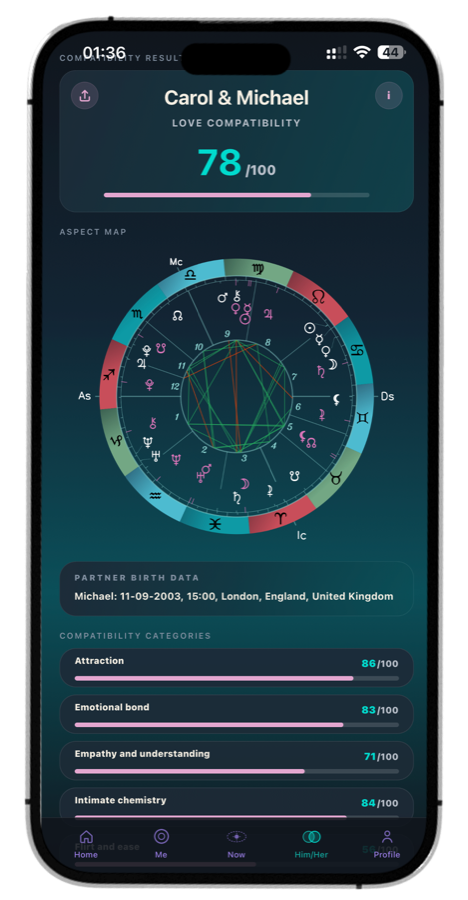
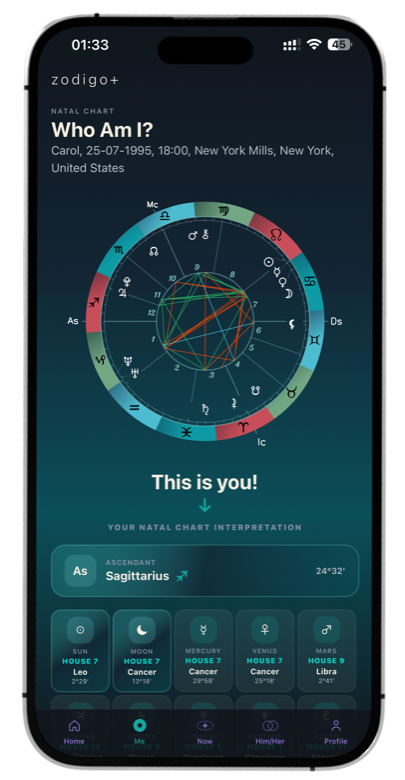
Zodigo reads aspects as part of a complete chart, not as isolated definitions. It can show how planets, signs, houses and aspect lines combine into personal meaning. This matters because the same aspect changes depending on the rest of the chart.
General astrology teaches the language. Zodigo helps you apply that language to your real birth data, current transits and compatibility patterns. Instead of wondering which generic description fits, you can see which aspect stories actually belong to you.
Zodigo uses a licensed, high-precision planetary calculation engine to calculate aspect geometry and orbs before turning those patterns into readable interpretations.
FAQ
How Planetary Aspects Shape a Birth Chart questions
Why are aspects important in a birth chart?
They show how planetary functions interact, creating flow, tension, talent and growth themes.
Are aspects more important than signs?
Both matter. Signs show style, while aspects show relationship and dynamic movement between planets.
What makes an aspect strong?
A tight orb, personal planets, angles, chart ruler involvement and repeated themes can make an aspect strong.
Can aspects change over time?
Natal aspects stay the same, but transits and life experience change how they are activated and expressed.
Inside the Zodigo app
An astrology app powered by high-precision NASA/JPL data
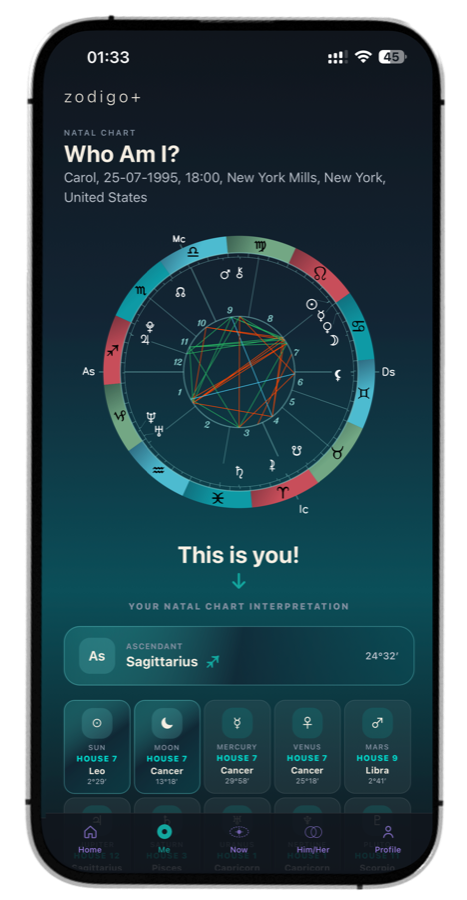
Your personal birth chart
See planets, houses, and aspects calculated from your exact birth details.
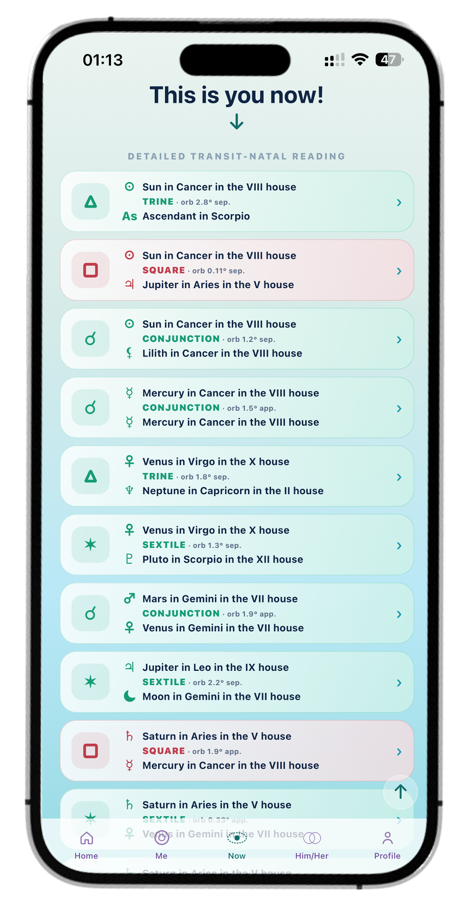
Transits right now
Follow the current sky and see how each transit affects your natal chart and all your personal planets.
Compatibility
Compare two natal charts and get a detailed synastry reading for love, family, friendship, or work. Explore attraction, emotional closeness, communication styles, points of tension, and long-term relationship dynamics through the aspects between two people's planets.