BIRTH CHART BASICS
How Is a Birth Chart Calculated?
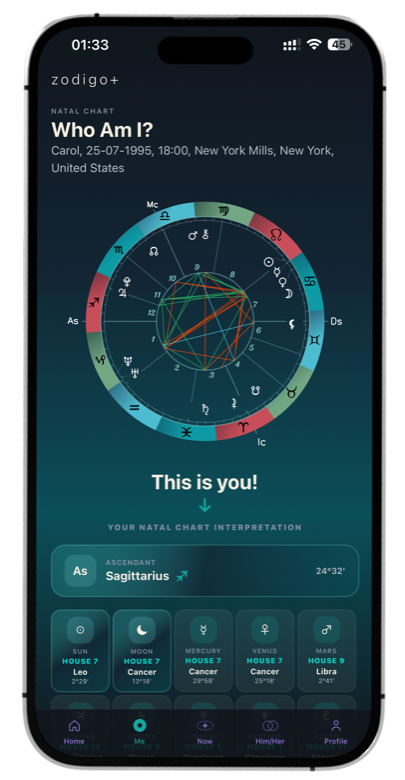
A birth chart is calculated by finding the astronomical positions of the Sun, Moon, planets and chart points for a specific date, exact time and location. The calculation turns a birth moment into a circular astrology chart. The date gives planetary positions, while time and place determine the horizon, rising sign, Midheaven and houses.
The three inputs: date, time and place
Every birth chart begins with three pieces of information: birth date, birth time and birthplace. The date tells the calculation which day of planetary motion to use. The time narrows the chart to a specific moment. The location tells the system where the horizon and meridian were from that place on Earth.
If one input changes, the chart can change. Planetary signs usually move slowly enough that a small time difference may not change every planet, but the Ascendant and houses can shift quickly. That is why astrologers ask for birth time when possible.
Planetary positions come first
The first calculation layer is planetary position. The system identifies where the Sun, Moon and planets were along the zodiac at the birth moment. These positions are usually expressed by zodiac sign and degree, such as Moon at 13 degrees Cancer or Venus at 25 degrees Virgo.
The Moon moves quickly compared with most planets, so it is more time-sensitive. Mercury and Venus can also change signs near a birth date. Outer planets move slowly and can stay in the same sign for long periods, but their aspects to personal planets can still be meaningful.
The rising sign and houses depend on location
The rising sign is the sign appearing on the eastern horizon at the birth moment. Because Earth rotates, the rising sign changes throughout the day. Birthplace matters because the horizon is different from one location to another. This is why two people born at the same instant in different cities can have different house layouts.
The houses are built from the relationship between the zodiac and the local sky. Different house systems divide the chart slightly differently, but the basic purpose is the same: to place planets into life areas such as identity, home, relationships, work and public direction.
Aspects are measured angles
After planets are placed, the chart can measure aspects. An aspect is an angular relationship between two planets. A conjunction is close together, an opposition is about 180 degrees apart, a square is about 90 degrees, a trine is about 120 degrees and a sextile is about 60 degrees.
The allowed distance from an exact aspect is called the orb. A tight orb often feels stronger because the planets are closer to the exact geometric relationship. Wider orbs may still matter, especially when the planets are central in the chart.
Calculation is not the same as interpretation
Birth chart calculation is technical. It answers where the planets and chart points were. Interpretation is symbolic. It asks what those placements may describe in personality, timing, relationships and life themes. Confusing these two layers can make astrology sound less precise than it is.
A reliable app should calculate the chart first, then interpret the result. Zodigo uses structured chart data so the interpretation is connected to actual placements, houses, aspects and transits rather than generic zodiac text.
Why calculation and interpretation are different skills
A birth chart calculation answers a technical question: where were the planets and chart points at a specific time and place? The result depends on astronomical data, time zones, coordinates and a chosen house system. Interpretation answers a different question: what might those positions symbolize in a person’s life? These two layers should not be confused. A chart can be calculated precisely, while the interpretation still needs care, context and judgment.
This is also why two astrology tools can feel different even when they use the same birth data. One may choose a different house system, emphasize different aspects or explain placements in a more general way. The stronger approach is to make the calculation transparent and then interpret the full pattern. Zodigo focuses on personal chart context: the result is not just a list of positions, but a reading that connects placements, houses, aspects, transits and compatibility themes.
This is why Zodigo uses a licensed, high-precision planetary calculation engine: the interpretation is only useful when the planetary positions, angles, houses and aspects are calculated from reliable birth data.
Why exact data protects the reading from becoming generic
The more exact the input data, the less generic the chart has to be. A date alone can show planetary signs, but it cannot reliably show the full house system. A city alone is not enough without time. A time without location is also incomplete because the sky is viewed from a specific place on Earth. Birth chart calculation is personal because it ties the same sky to one exact horizon.
That is why a real birth chart calculator asks for date, time and birthplace. It is not extra decoration; it is the basis for the Ascendant, houses, angles and many personal timing details. Zodigo uses this complete input so the reading can speak about your actual chart, not only the broad planetary positions shared by many people born around the same day.
Why accuracy matters
Small data errors can create different interpretations. A wrong birth time can change the rising sign or move planets into different houses. A wrong city can affect house cusps and angles. A wrong date can obviously change the whole chart.
This is why entering accurate birth data is the best way to get a useful reading. Zodigo helps turn that data into a chart you can actually explore: planets, houses, aspects, current transits and compatibility patterns.
FAQ
How Is a Birth Chart Calculated? questions
What information do I need for a birth chart?
You need birth date, birth time and birthplace. Exact birth time is especially important for the rising sign and houses.
Can a birth chart be calculated without birth time?
Some planet signs and aspects can still be calculated, but the Ascendant, Midheaven and houses may not be reliable.
What changes fastest in a birth chart?
The Ascendant and houses change quickly because they depend on Earth rotation and local horizon.
Are birth chart calculations the same in every app?
They should be close when the same data, zodiac and house system are used, but settings and data quality can cause differences.
Inside the Zodigo app
An astrology app powered by high-precision NASA/JPL data
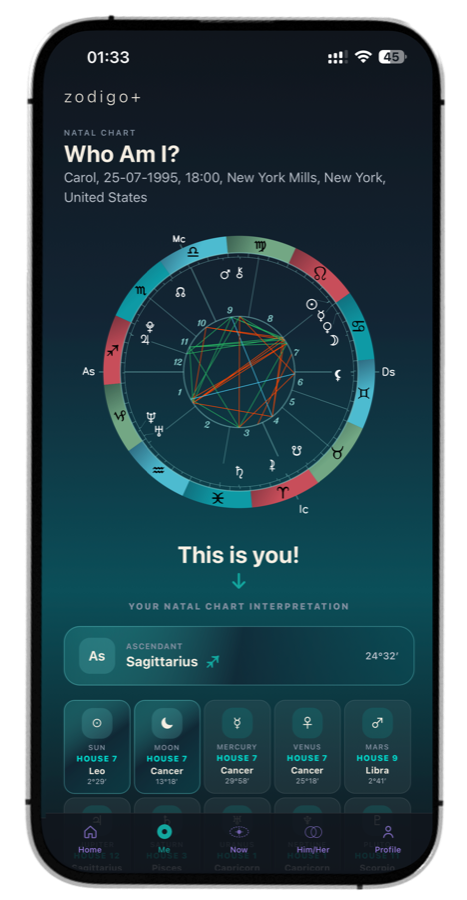
Your personal birth chart
See planets, houses, and aspects calculated from your exact birth details.
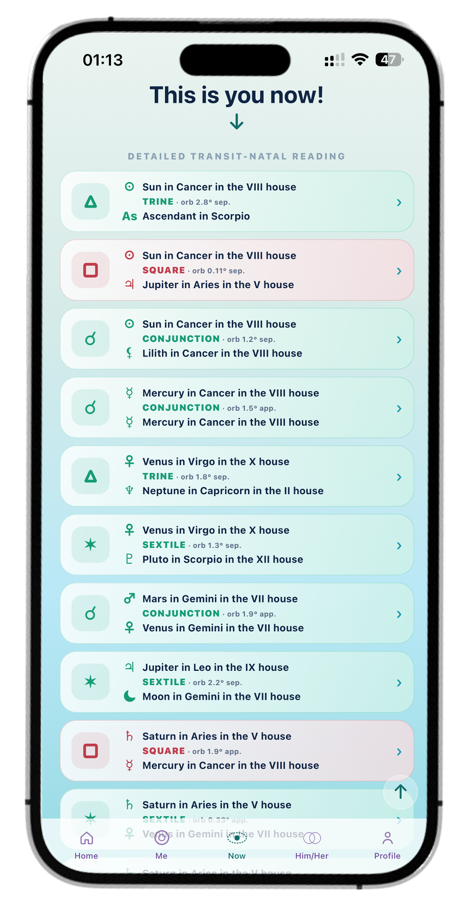
Transits right now
Follow the current sky and see how each transit affects your natal chart and all your personal planets.
Compatibility
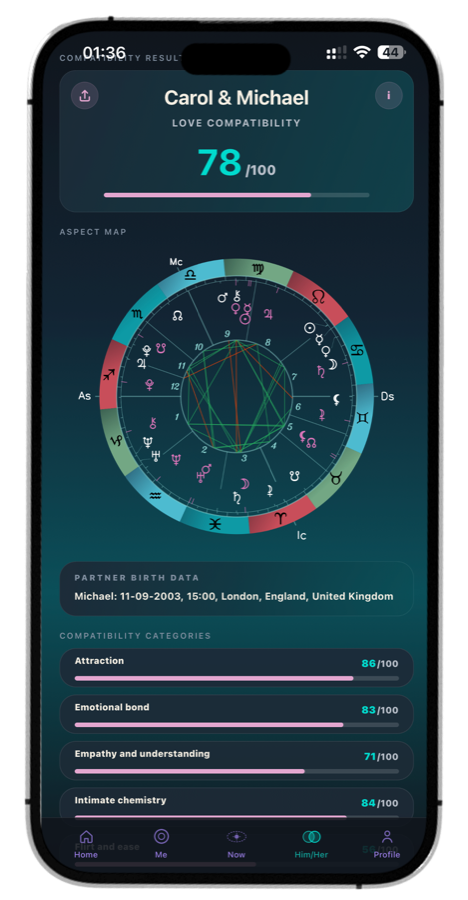
Compare two natal charts and get a detailed synastry reading for love, family, friendship, or work. Explore attraction, emotional closeness, communication styles, points of tension, and long-term relationship dynamics through the aspects between two people's planets.