BIRTH CHART BASICS
Birth Chart Explained for Beginners
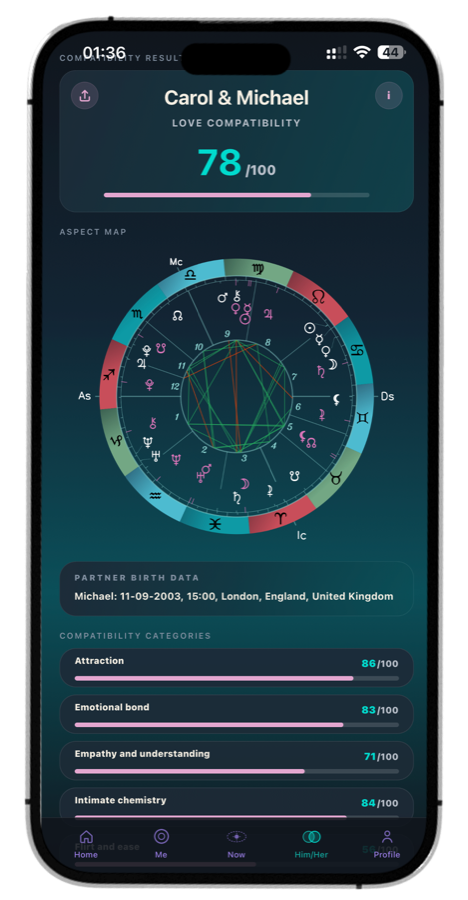
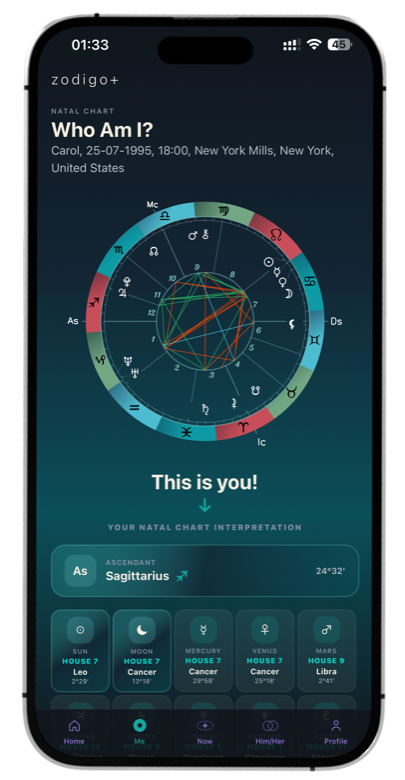
A birth chart can look complicated at first, but it becomes easier when you understand its basic grammar. The chart is not one symbol and it is not only your zodiac sign. It is a map made of planets, signs, houses and aspects, calculated from the exact sky at your birth. Each layer adds a different kind of information.
BEGINNER CHART SYMBOLS
These planets are usually the easiest starting point before moving into houses and advanced patterns.
Think of the chart as a map, not a label
A beginner often asks, “What does my sign mean?” That is a useful start, but a birth chart is not a single label. It is a map with many symbols working together. The Sun may describe identity, the Moon may describe emotional needs, and the rising sign may describe how life meets you from the outside.
This is why astrology becomes more interesting when you move beyond stereotypes. A birth chart can show why someone feels bold in one area, cautious in another and deeply sensitive somewhere else. The chart is a symbolic language for complexity.
The planets are the actors
Planets describe the parts of life that are expressing themselves. Mercury thinks and speaks. Venus relates and values. Mars pursues and defends. Jupiter searches for meaning and growth. Saturn asks for discipline, limits and maturity. The outer planets describe slower collective and generational themes that can still be personal when they connect strongly to the chart.
For beginners, it helps to memorize the planets as verbs. Mercury communicates, Venus attracts, Mars acts, Jupiter expands and Saturn structures. Once you know what the planet is doing, you can ask how and where it does it.
Signs describe style
A zodiac sign describes the style or tone of a planet. Mars in Aries may act quickly and directly. Mars in Libra may act through negotiation, comparison or partnership. The planet is still Mars, but the sign changes the way Mars behaves.
This is why two people with the same planet can express it very differently. Venus in Taurus may seek steadiness, touch and consistency. Venus in Sagittarius may need freedom, humor and discovery. The sign gives the planet a language.
Houses describe life areas
The houses divide the chart into twelve areas of life. The first house relates to identity and presence. The second house relates to resources and self-worth. The seventh house relates to partnership. The tenth house relates to career, visibility and public direction. Every house gives a placement a location.
If you see many planets in one house, that area may be especially important. A person with several planets in the fourth house may be strongly shaped by home, family, privacy or belonging. A person with several planets in the ninth house may be pulled toward learning, travel, worldview or meaning.
Aspects show the relationships inside the chart
Aspects are connections between planets. They can describe flow, tension, pressure, attraction or integration. A trine can feel natural. A square can feel demanding. An opposition can describe a polarity that needs balance. A conjunction blends two planets into one strong focus.
Beginners should avoid judging aspects too quickly. A hard aspect does not mean failure, and a soft aspect does not guarantee happiness. Aspects show dynamics. The person still has choices, awareness and development.
A beginner-friendly order for reading your chart
If you are new to astrology, do not try to understand every symbol at once. Begin with the chart’s center of gravity. First read the Sun, Moon and rising sign. Then read Mercury, Venus and Mars because they describe thinking, love style and motivation in everyday life. After that, look at the houses that contain the most planets. Finally, read the tightest aspects because they show the strongest inner connections and tensions.
This order keeps the birth chart from feeling like a maze. It also prevents the beginner mistake of jumping straight into rare objects or advanced techniques before the main structure is understood. A chart can contain many details, but the foundation is always the same: planets, signs, houses and aspects. Zodigo is designed to make that foundation easier to explore, with personal explanations that start from your actual birth data instead of generic zodiac summaries.
Zodigo does not guess the chart from a Sun sign. It uses a licensed, high-precision planetary calculation engine so planets, angles, houses and aspects can be read from your exact birth data.
What beginners should ignore at first
Beginners often feel they must learn every asteroid, fixed star and advanced timing method immediately. That usually creates confusion. The strongest first step is to understand the ten main planets, the Ascendant, the twelve houses and the major aspects. Once those symbols make sense, extra points can become useful. Before that, they can distract from the basic grammar of the chart.
A simple rule helps: if a placement repeats a theme already visible in the main chart, it may be worth exploring. If it introduces a tiny detail that does not connect to anything else, save it for later. Zodigo keeps the focus on the personal structure first, which is exactly what a beginner needs when learning astrology without getting lost.
Start simple and build gradually
The best beginner approach is not to read every placement at once. Start with the Sun, Moon and rising sign. Then add Mercury, Venus and Mars. Then notice which houses are emphasized and which aspects repeat. Each step gives the chart more shape.
Zodigo makes this easier by organizing your chart into personal interpretations. Instead of trying to decode every symbol alone, you can open your chart and read how your planets, houses and aspects work together.
FAQ
Birth Chart Explained for Beginners questions
Is a birth chart hard to learn?
It can look complex, but it becomes manageable when you learn planets, signs, houses and aspects one layer at a time.
What are the most important parts for beginners?
The Sun, Moon, rising sign, personal planets, house emphasis and major aspects are the best starting points.
Is my Sun sign enough?
No. The Sun sign matters, but the full birth chart gives much more personal detail.
Can Zodigo explain my chart?
Yes. Zodigo shows personal interpretations for your planets, houses, aspects, transits and compatibility.
Inside the Zodigo app
An astrology app powered by high-precision NASA/JPL data
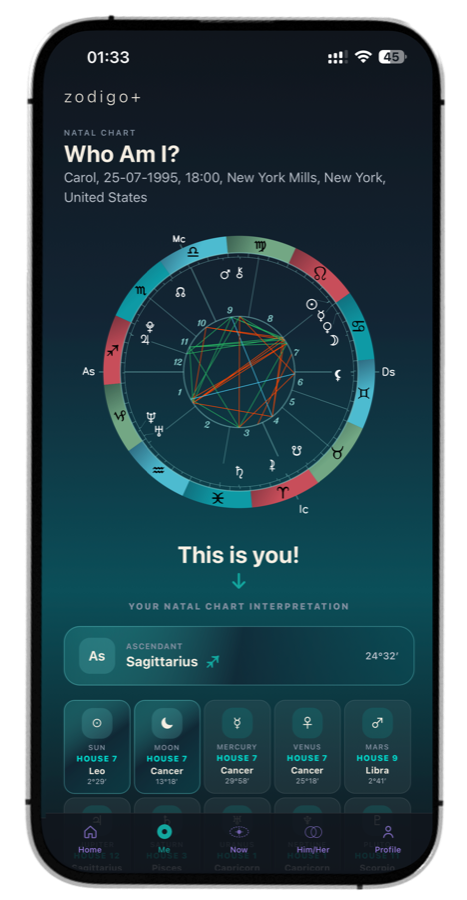
Your personal birth chart
See planets, houses, and aspects calculated from your exact birth details.
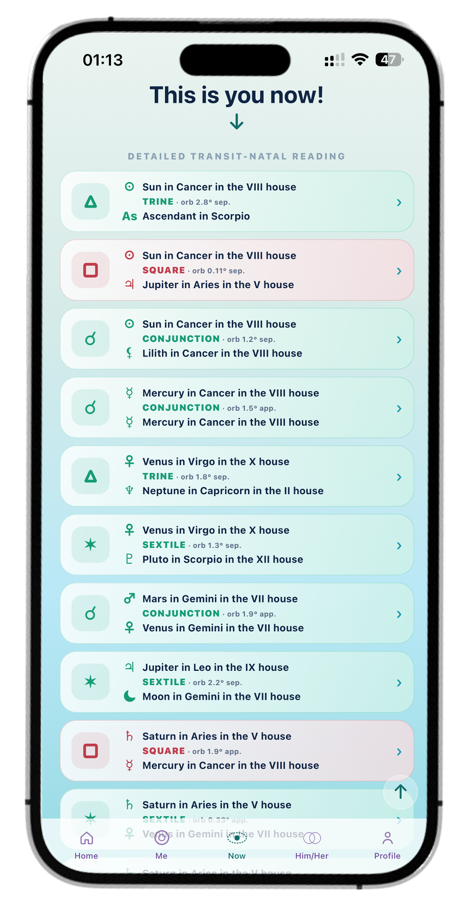
Transits right now
Follow the current sky and see how each transit affects your natal chart and all your personal planets.
Compatibility
Compare two natal charts and get a detailed synastry reading for love, family, friendship, or work. Explore attraction, emotional closeness, communication styles, points of tension, and long-term relationship dynamics through the aspects between two people's planets.