TRANSITS
What Are Astrological Transits?
Astrological transits are the movements of the planets happening now and the way those movements interact with your birth chart. Your natal chart is fixed at the moment of birth. Transits are alive and changing. When a planet in the sky forms an aspect to a natal planet, enters one of your houses or crosses an important point, astrologers read that contact as a temporary activation of a personal theme.
TRANSIT PLANETS
Current planets become personal when they contact your natal planets and houses.
The birth chart is the map, transits are the weather
A helpful way to understand transits is to separate the natal chart from the current sky. The natal chart describes your underlying structure: planets, signs, houses, aspects and chart angles. Transits describe what is moving through that structure now. The same sky happens for everyone, but it does not touch everyone’s birth chart in the same way.
For example, Jupiter may be moving through Cancer for the whole world, but one person may experience it in the first house, another in the seventh house and another as a trine to the Moon. The public transit is collective. The personal transit depends on birth data. That is why generic forecasts can feel broad while a transit-to-natal reading can feel specific.
Transits work through aspects and houses
The most common transit reading looks at aspects between transiting planets and natal planets. A transiting Saturn square natal Venus is different from transiting Jupiter trine natal Venus. One may emphasize responsibility, limits or emotional maturity. The other may emphasize ease, pleasure, generosity or social opening. The aspect describes the type of contact.
Houses describe the life area. A transit through the tenth house may activate career, visibility and reputation. A transit through the fourth house may activate home, family and private emotional foundations. When a transiting planet both moves through a house and aspects a natal planet, the reading becomes more detailed.
Fast planets and slow planets feel different
The Moon, Mercury, Venus and Mars move quickly, so their transits often describe short-term moods, conversations, desires, decisions and daily rhythm. The Moon may change the emotional tone for a day. Mercury can describe messages, planning and mental focus. Venus can describe pleasure, attraction and social ease. Mars can describe energy, urgency or irritation.
Jupiter, Saturn, Uranus, Neptune and Pluto move more slowly, so their transits usually describe longer chapters. Jupiter expands. Saturn tests and structures. Uranus awakens and disrupts. Neptune dissolves and sensitizes. Pluto deepens and transforms. These transits can last months or years, especially when retrograde motion repeats a contact.
Transits do not force one exact event
A transit is not a script that says one guaranteed event must happen. It describes a type of timing and a theme that becomes active. Saturn may coincide with responsibility, delay, commitment or boundaries. Jupiter may coincide with opportunity, confidence, learning or excess. The real expression depends on the natal chart, life context and choices.
This is why serious transit reading is reflective rather than fatalistic. It can help you understand what kind of pressure, opening or transition is present. It can help you plan, pause, focus or make a decision with better timing. It should not remove agency or make fear the center of the reading.
Why personal transit order matters
When many transits are active at once, priority matters. A tight Pluto aspect to the natal Moon usually deserves more attention than a quick Moon sextile to Venus. A Saturn transit to the Ascendant may describe a larger chapter than a one-day Mercury transit. Reading transits well means ranking the timing instead of treating every contact as equally important.
This is also why transit apps should not overwhelm people with every possible line. The useful question is simple: what is strongest right now, what life area does it touch and what kind of response does it ask for? That hierarchy turns astrology from noise into guidance.
Why transits feel personal in Zodigo
A list of current planetary positions is useful, but it is not enough. The question is how those positions touch your actual birth chart. A transit that strongly affects one person may barely touch another person. A retrograde cycle may repeat over one of your natal planets and become important, while someone else experiences it as background noise.
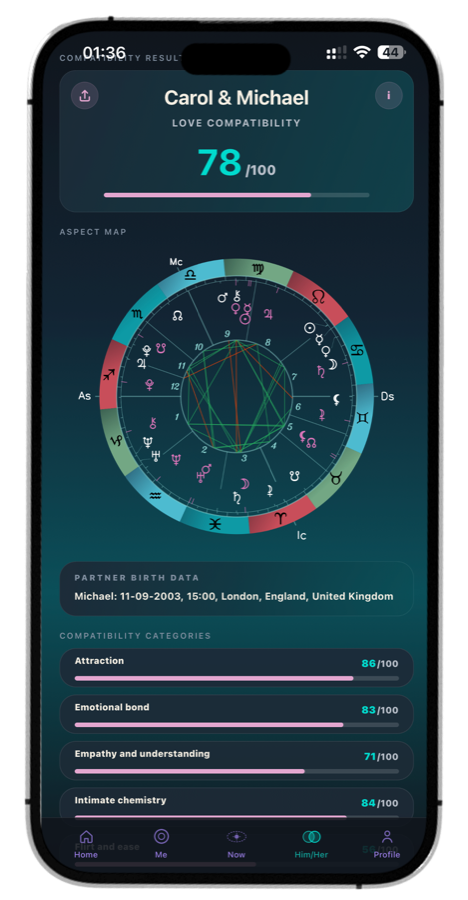
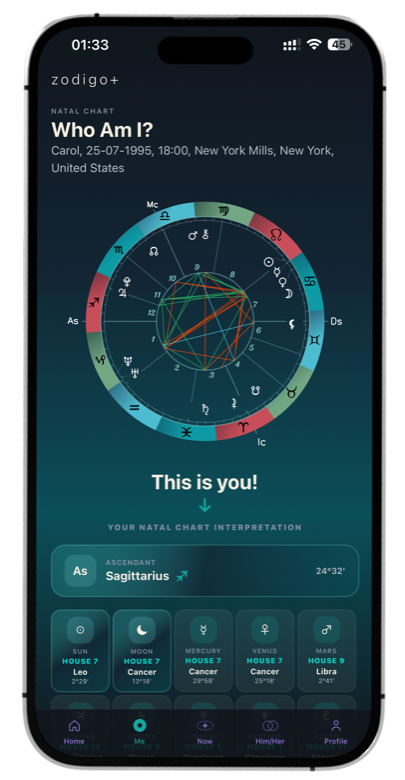
Zodigo calculates the current sky against your own natal chart, so you can see which transits are active for you. Instead of reading a generic horoscope, you can look at the real planetary contacts, houses and timing that belong to your chart.
For transits, precision matters because the current sky has to be compared with your natal chart. Zodigo uses a licensed, high-precision planetary calculation engine so the timing is based on real planetary positions, not generic sign-based guesses.
FAQ
What Are Astrological Transits? questions
What is a transit in astrology?
A transit is a current planetary movement that interacts with your natal chart by house, sign or aspect.
Are transits the same for everyone?
The sky is collective, but your personal transit reading depends on your exact birth chart.
Do transits predict events?
They describe timing themes and activations. They do not guarantee one fixed event.
Why do slow planet transits matter?
Slow planets can activate longer chapters because their contacts last longer and may repeat.
Inside the Zodigo app
An astrology app powered by high-precision NASA/JPL data
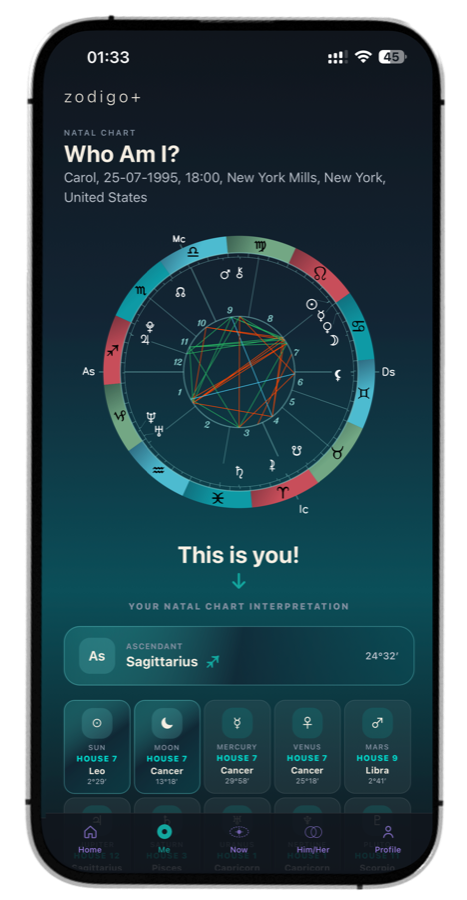
Your personal birth chart
See planets, houses, and aspects calculated from your exact birth details.
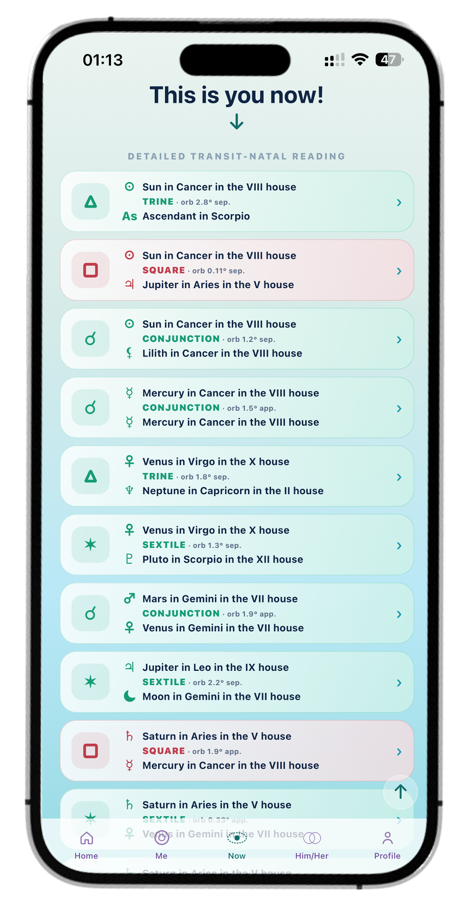
Transits right now
Follow the current sky and see how each transit affects your natal chart and all your personal planets.
Compatibility
Compare two natal charts and get a detailed synastry reading for love, family, friendship, or work. Explore attraction, emotional closeness, communication styles, points of tension, and long-term relationship dynamics through the aspects between two people's planets.