BIRTH CHART BASICS
What Do Aspects Mean in a Birth Chart?
Aspects in a birth chart are angular relationships between planets. They show how different parts of the chart interact. Some aspects feel smooth, some feel tense, and some feel intense or polarizing. Aspects are important because they explain why placements do not work separately. They form the internal conversations of the chart.
Aspects connect planets
A planet in a sign and house gives one piece of meaning. An aspect connects that planet to another planet. For example, Mercury describes thought and speech, while Saturn describes structure and limits. A Mercury-Saturn aspect may describe serious thinking, careful communication, self-criticism or disciplined study.
Without aspects, a chart can become a list. With aspects, it becomes a system. Planets support, challenge, pressure and modify one another.
Major aspects have different qualities
The conjunction blends planets together. The opposition creates a polarity that asks for balance. The square creates friction, motivation and conflict. The trine shows ease, flow and natural talent. The sextile shows opportunity, cooperation and skill that develops through use.
These meanings are starting points, not final judgments. A square can become productive through effort. A trine can be wasted if it is taken for granted. The person’s awareness matters.
Hard aspects and soft aspects
Squares and oppositions are often called hard aspects because they involve tension. They can feel demanding, but they can also create drive, clarity and growth. Hard aspects often show where a person cannot stay passive.
Trines and sextiles are often called soft aspects because they can feel easier. They may describe talent, support and natural understanding. But ease does not always mean development. Sometimes a soft aspect needs conscious use to become visible.
The planets matter as much as the angle
A Venus-Mars square does not mean the same thing as a Mercury-Saturn square. The angle gives the relationship style, but the planets tell you what life functions are involved. Venus and Mars may involve attraction, desire and values. Mercury and Saturn may involve thought, speech, fear and discipline.
This is why aspect interpretation must name both planets and the aspect. The chart is specific because the symbols combine.
Orbs show strength
The orb is the distance from an exact aspect. If two planets are exactly 90 degrees apart, the square is exact. If they are 87 or 93 degrees apart, the square is still active if the allowed orb includes that distance. Tighter orbs are often felt more strongly.
Different astrologers and apps use different orb settings. That can explain why one chart tool lists an aspect and another does not. The aspect may be near the edge of the allowed range.
Why aspects often explain the feeling of a chart
Aspects often describe why a chart feels easy in some areas and complicated in others. A trine between Mercury and Jupiter may make learning, speaking or big-picture thinking feel natural. A square between Venus and Saturn may bring lessons around closeness, trust, timing or fear of rejection. An opposition between Mars and Neptune may create tension between direct action and uncertainty. These patterns can feel very personal because they describe movement between inner parts.
Still, aspects should not be read as good or bad in a simple way. A square can become discipline and strength. A trine can become ease, talent or something taken for granted. The question is how conscious the person becomes of the pattern. Zodigo helps by explaining aspects in context, so the reading is not just “this is difficult” or “this is lucky,” but a clearer description of how the energy may work in real life.
Tight aspects usually matter more than loose aspects
In astrology, the orb is the distance between an exact aspect and the actual planet positions. A square that is almost exact usually feels stronger than a square with a wide orb. This is why serious aspect reading pays attention not only to the type of aspect, but also to closeness. A tight Moon-Saturn aspect can be a major emotional theme, while a loose outer-planet aspect may be less personal unless it connects to something central.
Aspects also become more important when they repeat a larger theme. If the chart already emphasizes responsibility, a Saturn aspect may speak loudly. If the chart already emphasizes freedom and change, Uranus aspects may become central. Zodigo gives aspect interpretations inside the full natal chart so the meaning is connected to the person, not isolated from the rest of the map.
Extra practical note
A birth chart without aspects can feel like a list of ingredients. Aspects show the recipe: which parts blend easily, which parts challenge each other and which parts create movement. Once you understand aspects, the chart starts to feel connected instead of scattered.
Zodigo turns aspects into readable interpretations
Zodigo helps you read aspects as part of your chart instead of as isolated formulas. You can see which planets are involved, what type of aspect they form and how that pattern may work in your life.
This is especially useful because aspects often explain the most personal parts of a chart: repeating emotional patterns, relationship dynamics, ambition, pressure, ease and inner contradiction.
Zodigo uses a licensed, high-precision planetary calculation engine to calculate aspect geometry and orbs before turning those patterns into readable interpretations.
FAQ
What Do Aspects Mean in a Birth Chart? questions
What is the strongest aspect in astrology?
Strength depends on orb, planets involved and chart emphasis. Tight aspects to the Sun, Moon, Ascendant or personal planets are often important.
Are square aspects bad?
No. Squares can feel tense, but they also create motivation, skill and growth when handled consciously.
What is an orb?
An orb is the allowed distance from an exact aspect. Tighter orbs are usually stronger.
Do aspects matter in compatibility?
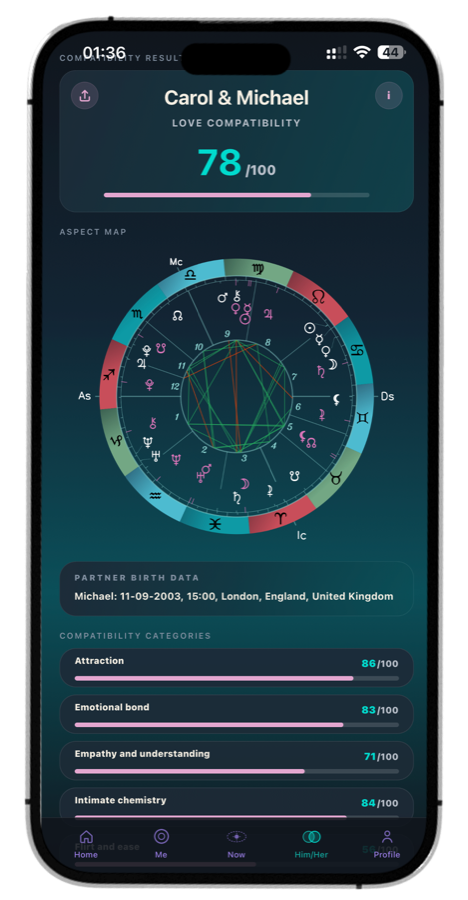
Yes. Synastry compares aspects between two charts to understand attraction, ease, tension and long-term dynamics.
Inside the Zodigo app
An astrology app powered by high-precision NASA/JPL data
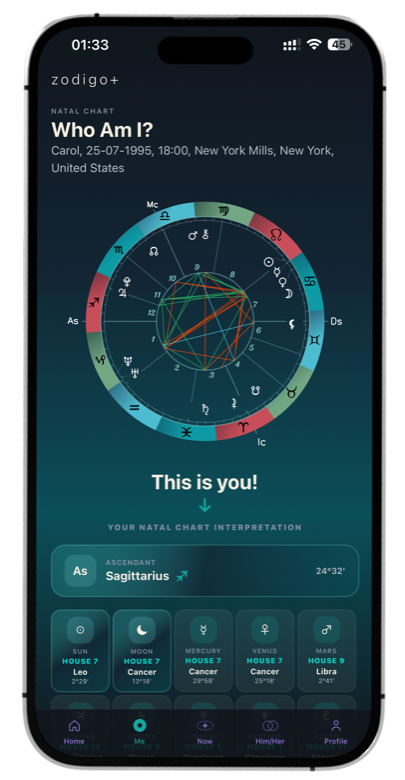
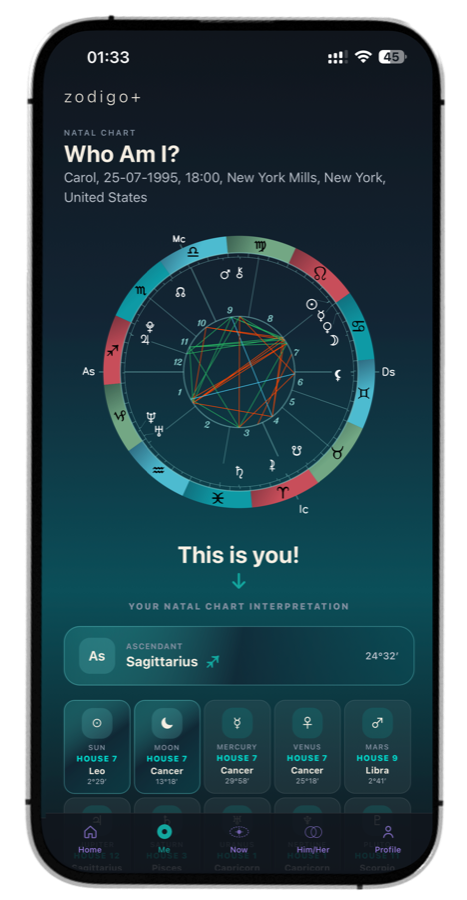
Your personal birth chart
See planets, houses, and aspects calculated from your exact birth details.
Transits right now
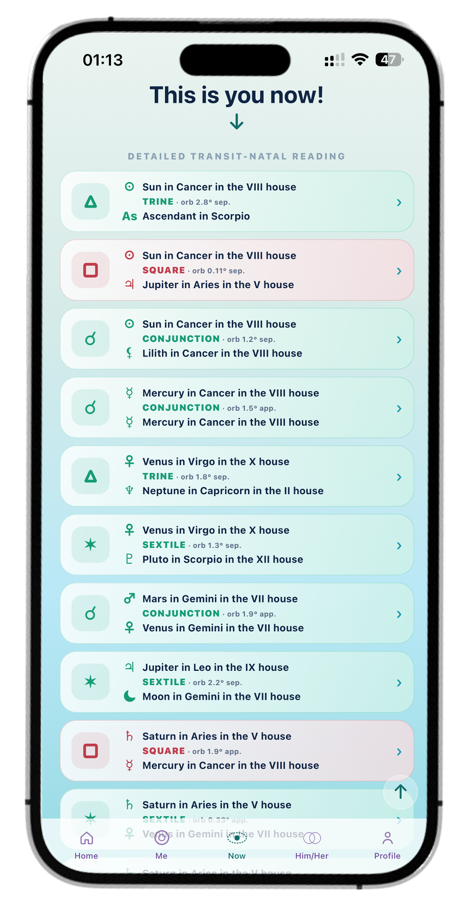
Follow the current sky and see how each transit affects your natal chart and all your personal planets.
Compatibility
Compare two natal charts and get a detailed synastry reading for love, family, friendship, or work. Explore attraction, emotional closeness, communication styles, points of tension, and long-term relationship dynamics through the aspects between two people's planets.